MCQ
The total kinetic energy of $8$ litres of helium molecules at $5$ atmosphere pressure will be:
  • A
    $6078\ erg$
  • $6078$ Joule
  • C
    $607\ erg$
  • D
    $607$ Joule

Answer

Correct option: B.
$6078$ Joule

Need a full question paper?

Generate a complete, print-ready paper with questions like this in minutes — across 16+ boards, with answer keys.
Start Generating Free

Similar questions

A body is moving in a room with a velocity of $20\, m / s$ perpendicular to the two walls separated by $5$ meters. There is no friction and the collisions with the walls are elastic. The motion of the body is
A system is oscillating with undamped simple harmonic motion. Then the
The value of acceleration due to gravity at Earth’s surface is $9.8\, m\,s^{-2}$. The altitude above its surface at which the acceleration due to gravity decreases to $4.9\, m\,s^{-2}$, is close to: (Radius of earth $= 6.4\times10^6\, m$)
A bomb is released from a horizontal flying aeroplane. The trajectory of bomb is
A particle is acted upon by a force $F$ which varies with position $x$ as shown in the figure. If the particle at $x = 0$ has the kinetic energy of $25J,$ then the kinetic energy of the particle at $x = 16m$ is?
Velocity of transverse wave in stretched string doesn't depend on:
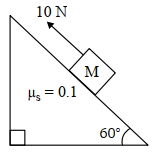
A block of mass $1 \mathrm{~kg}$ is pushed up a surface inclined to horizontal at an angle of $60^{\circ}$ by a force of $10 \mathrm{~N}$ parallel to the inclined surface as shown in figure. When the block is pushed up by $10 \mathrm{~m}$ along inclined surface, the work done against frictional force is: $\left[\mathrm{g}=10 \mathrm{~m} / \mathrm{s}^2\right]$
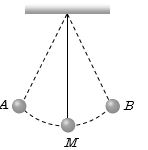
What is the velocity of the bob of a simple pendulum at its mean position, if it is able to rise to vertical height of $10\,cm$ ($g = 9.8\, m/s^2$) ..... $m/s$
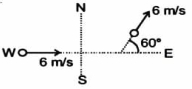
A particle is moving eastwards with a speed of $6 \,m / s$. After $6 \,s$, the particle is found to be moving with same speed in a direction $60^{\circ}$ north of east. The magnitude of average acceleration in this interval of time is ....... $m / s ^2$
Four spheres $A, B, C$ and $D$ are of same radius but made of different metals. Their densities are in ratio $6 : 3 : 4 : 5$ and specific heats are in ratio $2 : 5 : 4 : 6$ . These are initially kept at the same temperature and placed in the same surroundings. The sphere which has the slowest rate of cooling is