MCQ
The total mechanical energy of a spring$-$mass system in $1$ simple harmonic motion is $\text{E}=\frac{1}{2}\text{m}\omega^2\text{A}^2.$ Suppose the oscillating particle is replaced by another particle of double the mass while the amplitude $A$ remains the same. The new mechanical energy will:
  • A
    Become $2E$
  • B
    Become $\frac{\text{E}}{2}$
  • C
    Become $\sqrt{2\text{E}}$
  • Remain $E.$

Answer

Correct option: D.
Remain $E.$
Mechanical energy $(E)$ of a spring$-$mass system in simple harmonic motion is given by,
$\text{E}=\frac{1}{2}\text{m}\omega^2\text{A}^2$
where $m$ is mass of body, and $\omega$ is angular frequency.
Let $m_1$ be the mass of the other particle and $\omega_1$ be its angular frequency.
New angular frequency $\omega_1$ is given by,
$\omega_1=\sqrt{\frac{\text{k}}{\text{m}_1}}=\sqrt{\frac{\text{k}}{2\text{m}}}\big(\text{m}_1=2\text{m}\big)$
New energy $E_1$ is given as,
$\text{E}_1=\frac{1}{2}\text{m}_1\omega_1^2\text{A}^2$
$=\frac{1}{2}\big(2\text{m}\big)\Big(\sqrt{\frac{\text{k}}{2\text{m}}}\Big)^2\text{A}^2$
$=\frac{1}{2}\text{m}\omega^2\text{A}^2=\text{E}$

Need a full question paper?

Generate a complete, print-ready paper with questions like this in minutes — across 16+ boards, with answer keys.

Start Generating Free

Similar questions

The work done in which of the following processes is zero
Two satellites $S _{1}$ and $S _{2}$ are revolving in circular orbits around a planet with radius $R _{1}=3200 \,km$ and $R _{2}=800\, km$ respectively. The ratio of speed of satellite $S_{1}$ to the speed of satellite $S_{2}$ in their respective orbits would be $\frac{1}{ x }$ where $x =$
An object moves at a constant speed along a circular path in horizontal $XY$ plane with centre at origin. When the object is at  $x = -2\,m$ , its velocity is $-(4\,m/ s)\hat j$ . What is object's acceleration when it is at $y = 2\,m$ ?
A stone is allowed to fall freely from rest. The ratio of the time taken to fall through the first meter and the second meter distance is:
During an isothermal expansion, a confined ideal gas does $-150 \,J$ of work against its surroundings. This implies that
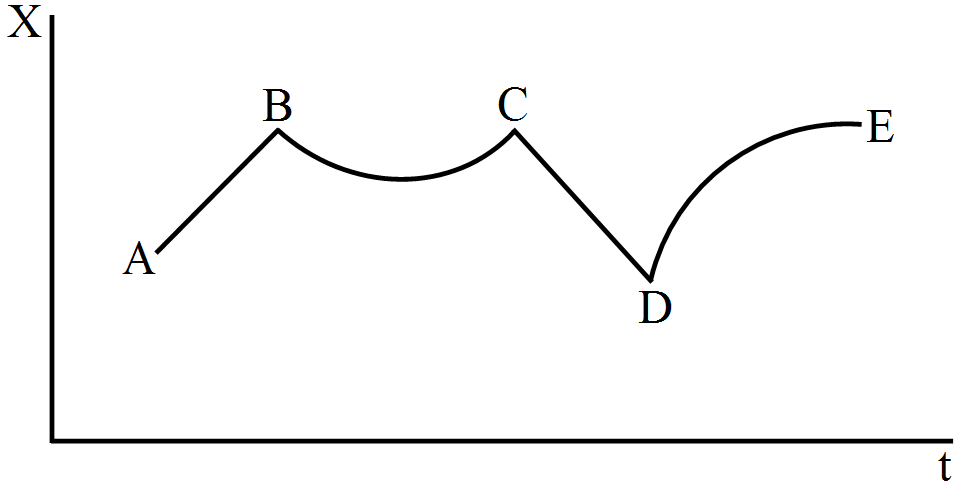
Figure shows the displacement of a particle going along the $X-$axis as a function of time. The force acting on the particle is zero in the region:
  1. $AB$
  2. $BC$
  3. $CD$
  4. $DE$
Which thermodynamic property do systems have in comman when they are in thermal equilibrium?
A tuning fork vibrating with a sonometer having $20 cm$ wire produces $5$ beats per second. The beat frequency does not change if the length of the wire is changed to $21 cm.$ the frequency of the tuning fork (in Hertz) must be
What is the torque of the force $\mathop F\limits^ \to   = (2\hat i - 3\hat j + 4\hat k)N$ acting at the pt. $\mathop r\limits^ \to   = (3\hat i + 2\hat j + 3\hat k)\,m$ about the origin
A coin is placed on a disc. The coefficient of friction between the coin and the disc is $\mu$. If the distance of the coin from the center of the disc is $r$, the maximum angular velocity which can be given to the disc, so that the coin does not slip away, is: