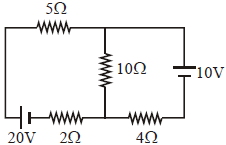
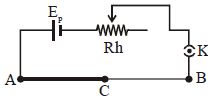
The total power dissipated in watts in the circuit shown is ............. $W$
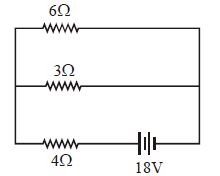
Medium


Download our appand get started for free
Experience the future of education. Simply download our apps or reach out to us for more information. Let's shape the future of learning together!No signup needed.*
Similar Questions
- 1A cell whose e.m.f. is $2\, V$ and internal resistance is $0.1\,\Omega $, is connected with a resistance of $3.9\,\Omega $. The voltage across the cell terminal will be ................ $V$View Solution
- 2A current of $5\; {A}$ is passing through a non-linear magnesium wire of cross-section $0.04\; {m}^{2}$. At every point the direction of current density is at an angle of $60^{\circ}$ with the unit vector of area of cross-section. The magnitude of electric field at every point of the conductor is ....${V} / {m}$ (Resistivity of magnesium is $\rho=44 \times 10^{-8}\, \Omega m$)View Solution
- 3What equal length of an iron wire and a copper-nickel alloy wire, each of $2 \; {mm}$ diameter connected parallel to give an equivalent resistance of $3 \Omega ?$View Solution
(Given resistivities of iron and copper-nickel alloy wire are $12 \;\mu \Omega {cm}$ and $51\; \mu \Omega {cm}$ respectively) (in ${m}$)
- 4On giving $220\,V$ to a resistor the power dissipated is $40\,W$ then value of resistance is ............... $\Omega$View Solution
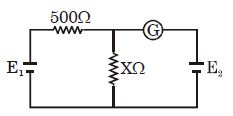
- 5In the adjoining circuit, the battery $E_1$ has an $e.m.f.$ of $12\, volts$ and zero internal resistance, while the battery $E_2$ has an $e.m.f.$ of $2\, volts$. If the galvanometer $G$ reads zero, then the value of the resistance $X$ in $ohms$ isView Solution
- 6What length of the wire of specific resistance $48 \times {10^{ - 8}}\,\Omega \,\,m$ is needed to make a resistance of $4.2 \, \Omega$ .............. $m$ (diameter of wire = $0.4\, mm$)View Solution
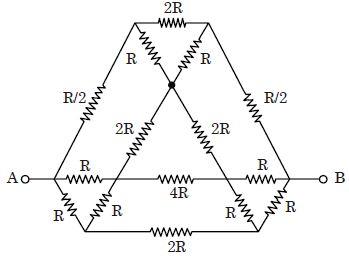
- 7For the shown circuit, find the effective resistance between the points $A$ and $B$.View Solution
- 8View SolutionElectromotive force is the force, which is able to maintain a constant
- 9A potentiometer consists of two wires $AC$ and $CB$ of same material and of equal lengths but diameters in the ratio $3 : 1.$ Then the potential gradients on the two wires will be in the ratio :-View Solution
- 10In the figure shown, the current in the $10\, V$ battery is close toView Solution