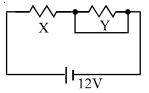
Electromotive force is the force, which is able to maintain a constant
Easy


Download our appand get started for free
Experience the future of education. Simply download our apps or reach out to us for more information. Let's shape the future of learning together!No signup needed.*
Similar Questions
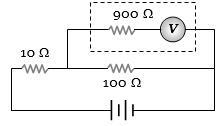
- 1The potential difference across the $100\,\Omega$ resistance in the following circuit is measured by a voltmeter of $900 \,\Omega$ resistance. The percentage error made in reading the potential difference isView Solution
- 2View SolutionThe relaxation time in conductors
- 3A horizontal conductor is oriented north south and carries some current. $A$ positively charged particle located vertically above it and having a velocity directed north ward experiences an upward force.What is the direction of the force if this charged particle were located to the east of the conductor and had a velocity directed towards the conductorView Solution
- 4Two wires that are made up of two different materials whose specific resistance are in the ratio $2 : 3$, length $3 : 4$ and area $4 : 5$. The ratio of their resistances isView Solution
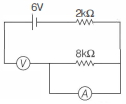
- 5In the circuit shown below, a student performing Ohm's law experiment accidently puts the voltmeter and the ammeter as shown in the circuit below. The reading in the voltmeter will be close to .......... $V$View Solution
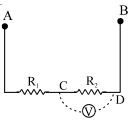
- 6Resistances $R_1$ and $R_2$ each $60\,\Omega$ are connected in series as shown in figure. The Potential difference between $A$ and $B$ is kept $120$ volt. Then what ............. $V$ will be the reading of voltmeter connected between the point $C$ and $D$ if resistance of voltmeter is $120\,\Omega .$View Solution
- 7A piece of wire of resistance $4\, ohms$ is bent through $180^o$ at its mid point and the two halves are twisted together, then the resistance is ............ $ohms$View Solution
- 8The charge of an electron is $1.6 × 10^{-19}\,C$. How many electrons strike the screen of a cathode ray tube each second when the beam current is $16\,mA$View Solution
- 9View SolutionA thick wire is stretched so that its length become two times. Assuming that there is no change in its density, then what is the ratio of change in resistance of wire to the initial resistance of wire
- 10When an ammeter of negligible internal resistance is inserted in series with circuit it reads $1A$. When the voltmeter of very large resistance is connected across $X$ it reads $1V$. When the point $A$ and $B$ are shorted by a conducting wire, the voltmeter measures $10\, V$ across the battery. The internal resistance of the battery is equal to .............. $\Omega$View Solution