MCQ
The triangle formed by ${x^2} - 9{y^2} = 0$ and $x = 4$ is
- ✓Isosceles
- BEquilateral
- CRight angled
- DNone of these
We have ${x^2} - 9{y^2} = 0$
So equation of line is,
$x - 3y = 0$.....$(i)$
$x + 3y = 0$.....$(ii)$
$x = 4$.....$(iii)$
By solving $(i)$, $(ii)$ and $(iii)$ we get
$A(0,\,0),\,\,B\,\left( {4,\,\frac{{ - 4}}{3}} \right),\,\,C\,\left( {4,\,\frac{4}{3}} \right)$
Now, $AB = \sqrt {{{(4 - 0)}^2} + {{\left( {0 + \frac{4}{3}} \right)}^2}} = \frac{{4\sqrt {10} }}{3}$
$AC = \sqrt {{{(4 - 0)}^2} + {{\left( {0 - \frac{4}{3}} \right)}^2}} = \frac{{4\sqrt {10} }}{3}$
$BC = \sqrt {{{(4 - 4)}^2} + {{\left( {\frac{4}{3} + \frac{4}{3}} \right)}^2}} = \frac{8}{3}$
Hence $ABC$ is an isosceles triangle.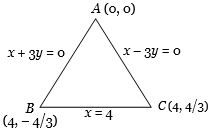
Generate a complete, print-ready paper with questions like this in minutes — across 16+ boards, with answer keys.
up to $n-$terms, where $a > 1$. If $S_{24}(x)=1093$ and $S _{12}(2 x )=265,$ then value of $a$ is equal to ..... .