Question
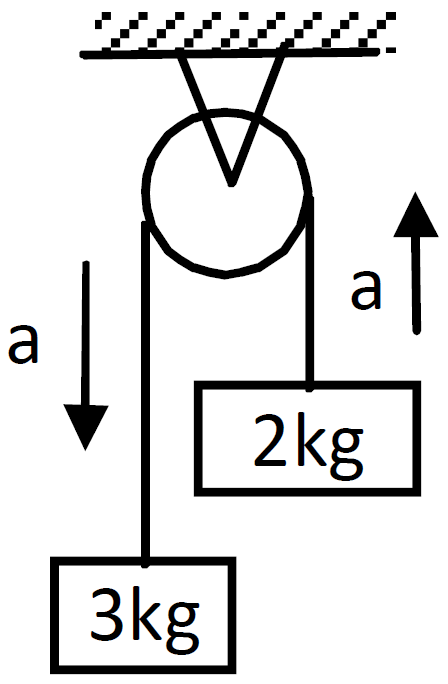
The two blocks in an Atwood machine have masses $2.0kg$ and $3.0kg$. Find the work done by gravity during the fourth second after the system is released from rest.
Answer

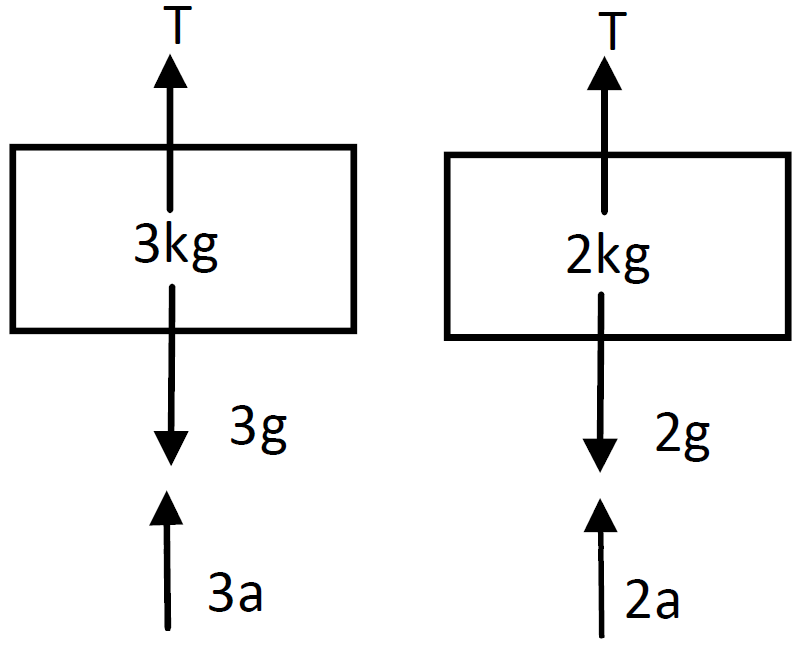
Given, $m_1 = 3 kg, m_2 = 2kg$, t = during $4^{th}$ second From the freebody diagram,


T - 3g + 3a = 0 ...(i) T - 2g - 2a = 0 ...(ii) Equation (i) & (ii), we get 3g – 3a = 2g + 2a $\Rightarrow\text{a}=\frac{\text{g}}{5}\text{m}/\text{sec}^2$ Distance travelled in $4^{th}$ sec is given by, $\text{S}_{4\text{th}}=\frac{\text{a}}{2}(2\text{n}-1)$ $=\frac{\Big(\frac{\text{g}}{5}\Big)}{\text{S}}(2\times4-1)$
$=\frac{7\text{g}}{10}=\frac{7\times9.8}{10}\text{m}$ Net mass $‘m’ = m_1 - m_2 = 3 - 2 = 1kg$ So, decrease in P.E. = mgh $=1\times9.8\times\frac{7}{10}\times9.8$
$=67.2=67\text{J}$

Need a full question paper?

Generate a complete, print-ready paper with questions like this in minutes — across 16+ boards, with answer keys.
Start Generating Free

Similar questions

A wire stretched between two rigid supports vibrates in its fundamental mode with a frequency of $45Hz$. The mass of the wire is $3.5 \times 10^{–2}kg$ and its linear mass density is $4.0 \times 10^{–2}kg m^{–1}$. What is
  1. The speed of a transverse wave on the string,
  2. The tension in the string?
Show that in the case of a closed organ pipe, the ratio of the frequencies of the harmonics is 1 : 3 : 5 : 7.
A bar magnet of length $1cm$ and cross-sectional area $1.0cm^2$ produces a magnetic field of $1.5 \times 10$. T at a point in end-on position at a distance $15cm$ away from the centre.
  1. Find the magnetic moment M of the magnet.
  2. Find the magnetization I of the magnet.
  3. Find the magnetic field B at the centre of the magnet.
The plates of a capacitor are 2.00cm apart. An electronproton pair is released somewhere in the gap between the plates and it is found that the proton reaches the negative plate at the same time as the electron reaches the positive plate. At what distance from the negative plate was the pair released?
Define velocity and acceleration. Draw a velocity time graph for uniformly accelerated motion and prove that the area between the curve of this graph and the time axis is equal to the displacement of the moving object
A capacitor of capacitance $5.00\mu\text{F}$ is charged to $24.0V$ and another capacitor of capacitance $6.0\mu\text{F}$ is charged to $12.0V$:
  1. Find the energy stored in each capacitor.
  2. The positive plate of the first capacitor is now connected to the negative plate of the second and vice versa. Find the new charges on the capacitors.
  3. Find the loss of electrostatic energy during the process.
  4. Where does this energy go?
In deriving Bernoulli’s equation, we equated the work done on the fluid in the tube to its change in the potential and kinetic energy.
  1. What is the largest average velocity of blood flow in an artery of diameter $2 × 10⁻³m$ if the flow must remain laminar?
  2. Do the dissipative forces become more important as the fluid velocity increases? Discuss qualitatively.
What is a fixed volume thermometer? Explain its principle. How is it better than a mercury thermometer?
A $5.0\mu\text{F}$ capacitor is charged to $12V$. The positive plate of this capacitor is now connected to the negative terminal of a $12V$ battery and vice versa. Calculate the heat developed in the connecting wires.
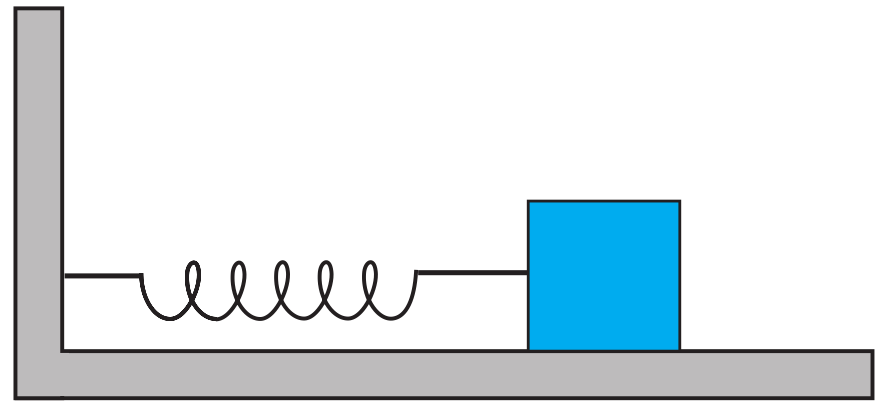
A spring having with a spring constant $1200N m^{-1}$ is mounted on a horizontal table as shown in Fig. A mass of $3kg$ is attached to the free end of the spring. The mass is then pulled sideways to a distance of $2.0cm$ and released.
Determine (i) the frequency of oscillations, (ii) maximum acceleration of the mass, and (iii) the maximum speed of the mass.