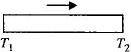
The two ends of a rod of length $L$ and a uniform cross-sectional area $A$ are kept at two temperatures $T_1$ and $T_2 (T_1 > T_2)$. The rate of heat transfer,$\frac{ dQ }{dt}$, through the rod in a steady state is given by
AIPMT 2009,AIIMS 2019, Easy


Download our appand get started for free
Experience the future of education. Simply download our apps or reach out to us for more information. Let's shape the future of learning together!No signup needed.*
Similar Questions
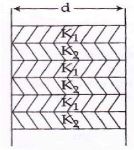
- 1A wall consists of alternating blocks of length $d$ and coefficient of thermal conductivity $K_{1}$ and $K_{2}$ respectively as shown in figure. The cross sectional area of the blocks are the same. The equivalent coefficient of thermal conductivity of the wall between left and right isView Solution
- 2A black body at $200 K$ is found to exit maximum energy at a wavelength of $14\mu m$. When its temperature is raised to $1000K$ , the wavelength at which maximum energy is emitted isView Solution
- 3Bottom of a lake is at $0^{\circ} C$ and atmospheric temperature is $-20^{\circ} C$. If $1 cm$ ice is formed on the surface in $24 \,h$, then time taken to form next $1 \,cm$ of ice is ......... $h$View Solution
- 4An ice box used for keeping eatable cold has a total wall area of $1\;metr{e^2}$ and a wall thickness of $5.0cm$. The thermal conductivity of the ice box is $K = 0.01\;joule/metre{ - ^o}C$. It is filled with ice at ${0^o}C$ along with eatables on a day when the temperature is $30°C$ . The latent heat of fusion of ice is $334 \times {10^3}joules/kg$. The amount of ice melted in one day is ........ $gms$ ($1day = 86,400\;\sec onds$)View Solution
- 5Three very large plates of same area are kept parallel and close to each other. They are considered as ideal black surfaces and have very high thermal conductivity. The first and third plates are maintained at temperatures $2\ T$ and $3\ T$ respectively. The temperature of the middle ($i.e.$ second) plate under steady state condition isView Solution
- 6The heat is flowing through a rod of length $50 cm$ and area of cross-section $5c{m^2}$. Its ends are respectively at ${25^o}C$ and ${125^o}C$. The coefficient of thermal conductivity of the material of the rod is $0.092 kcal/m×s×^\circ C$. The temperature gradient in the rod isView Solution
- 7View SolutionWhich of the following statement is correct
- 8A black body radiates at the rate of $W$ watts at a temperature $T$ . If the temperature of the body is reduced to $T/3$ , it will radiate at the rate of (in Watts)View Solution
- 9Instantaneous temperature difference between cooling body and the surroundings obeying Newton's law of cooling is $\theta$. Which of the following represents the variation of $\ln \theta$ with time $t$ ?View Solution
- 10The two ends of a metal rod are maintained at temperatures $100 ^o C$ and $110^o C$. The rate of heat flow in the rod is found to be $4.0\ J/s$. If the ends are maintained at temperatures $200^o\ C$ and $210^o\ C$, the rate of heat flow will be.... $J/s$View Solution