Three identical capacitors $\mathrm{C}_1, \mathrm{C}_2$ and $\mathrm{C}_3$ have a capacitance of $1.0 \mu \mathrm{F}$ each and they are uncharged initially. They are connected in a circuit as shown in the figure and $\mathrm{C}_1$ is then filled completely with a dielectric material of relative permittivity $\varepsilon_{\mathrm{r}}$. The cell electromotive force (emf) $V_0=8 \mathrm{~V}$. First the switch $S_1$ is closed while the switch $S_2$ is kept open. When the capacitor $C_3$ is fully charged, $S_1$ is opened and $S_2$ is closed simultaneously. When all the capacitors reach equilibrium, the charge on $\mathrm{C}_3$ is found to be $5 \mu \mathrm{C}$. The value of $\varepsilon_{\mathrm{r}}=$. . . .
(image)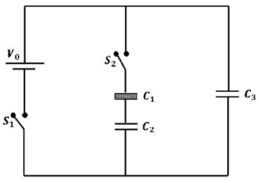
IIT 2018, Medium
Download our app for free and get started
(image)
Applying loop rule,
$\frac{5}{1}-\frac{3}{\varepsilon_{\mathrm{r}}}-\frac{3}{1}=0$
$2-\frac{3}{\varepsilon_{\mathrm{r}}}=0$
$\varepsilon_{\mathrm{r}}=\frac{3}{2}=1.50$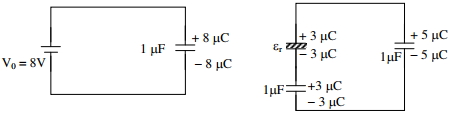

Download our appand get started for free
Experience the future of education. Simply download our apps or reach out to us for more information. Let's shape the future of learning together!No signup needed.*
Similar Questions
- 1The plates of a parallel plate capacitor of capacity $50\,\mu C$ are charged to a potential of $100\;volts$ and then separated from each other so that the distance between them is doubled. How much is the energy spent in doing soView Solution
- 2Electric potential at an equatorial point of a small dipole with dipole moment $P$ ($r$, distance from the dipole) isView Solution
- 3A solid conducting sphere of radius $R_1$ is surrounded by another concentric hollow conducting sphere of radius $R_2$. The capacitance of this assembly is proportional toView Solution
- 4A conducting sphere of radius $R$ is given a charge $Q$. The electric potential and the electric field at the centre of the sphere respectively areView Solution
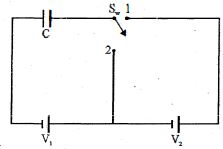
- 5The switch $S_w$ is shifted from position $1$ to position $2$ as shown in the figure. Heat generated in the circuit isView Solution
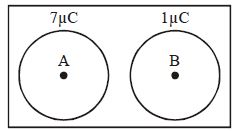
- 6$A$ and $B$ are two identical spheres charge on them is $7\,\mu C$ and $1\,\mu C$ respectively. Now both are connected by a wire. Calculate flow of charge from $A$ to $B$......$\mu C$View Solution
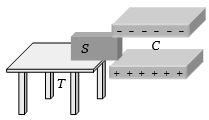
- 7A frictionless dielectric plate $S$ is kept on a frictionless table $T$. A charged parallel plate capacitance $C$ (of which the plates are frictionless) is kept near it. The plate $S$ is between the plates. When the plate $S$ is left between the platesView Solution
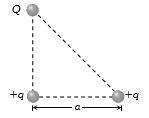
- 8Three charges $Q,\, + q$ and $ + q$ are placed at the vertices of a right-angled isosceles triangle as shown. The net electrostatic energy of the configuration is zero if $Q$ is equal toView Solution
- 9View SolutionThe ratio of charge to potential of a body is known as
- 10In the circuit shown initially $C_1, C_2$ are uncharged. After closing the switchView Solution