MCQ
The two structures $I$ and $II$ represents
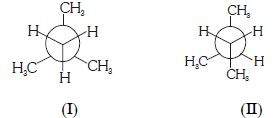
- AConformational isomers
- BStereoisomers
- ✓Structural isomers
- DIdentical
Generate a complete, print-ready paper with questions like this in minutes — across 16+ boards, with answer keys.
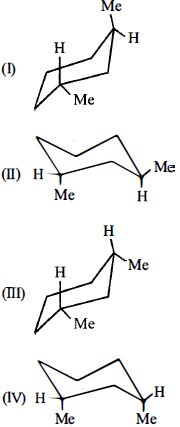
| Period number | Group number | |
| $P$ | $2$ | $15$ |
| $Q$ | $3$ | $2$ |
Then formula of the compound formed by $P$ and $Q$ element is
$E^o_{Cr^{3+}/Cr} =-0.74\, V,\,$ $E^o_{MnO_4^-/Mn^{2+}} =1.51 \,V$
$E^o_{Cr_2O_7^{2-}/Cr^3+} =1.33\,V:$ $E^o_{Cl/Cl^-} =1.36\,V$
Based on the data given above, strongest oxidising agent will be :
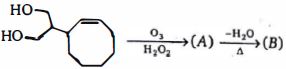
Statement I : $\left[\mathrm{Co}\left(\mathrm{NH}_3\right)_6\right]^{3+}$ is a homoleptic complex whereas $\left[\mathrm{Co}\left(\mathrm{NH}_3\right)_4 \mathrm{Cl}_2\right]^{+}$is a heteroleptic complex.
Statement II : Complex $\left[\mathrm{Co}\left(\mathrm{NH}_3\right)_6\right]^{3+}$ has only one kind of ligands but $\left[\mathrm{Co}\left(\mathrm{NH}_3\right)_4 \mathrm{Cl}_2\right]^{+}$has more than one kind of ligands.
In the light of the above statements, choose the correct answer from the options given below.