MCQ
The unit of absolute permittivity is
  • A
    $Fm$ (Farad-meter)
  • $F{m^{ - 1}}$ (Farad/meter)
  • C
    $F{m^{ - 2}}$(Farad/$metr{e^2}$)
  • D
    $F$ (Farad)

Answer

Correct option: B.
$F{m^{ - 1}}$ (Farad/meter)
b
(b)

Need a full question paper?

Generate a complete, print-ready paper with questions like this in minutes — across 16+ boards, with answer keys.
Start Generating Free

Similar questions

A bar magnet is released from rest along the axis of a very long, vertical copper tube. After some time the magnet:
According to Joule's law of heating, heat produced $H = {I^2}\,Rt$, where I is current, $R$ is resistance and $t$ is time. If the errors in the measurement of $I, R$ and t are $3\%, 4\% $ and $6\% $ respectively then error in the measurement of $H$ is
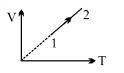
An ideal gas undergoes the process $1 \rightarrow 2$ as shown in the figure, the heat supplied and work done in the process is $\Delta \,\,Q$ and $\Delta \,\,W$ respectively. The ratio $\Delta \,\,Q :$ $\Delta \,\,W$ is
If an ideal gas is compressed isothermally then
A hollow spherical shell at outer radius $R$ floats just submerged under the water surface. The inner radius of the shell is $r$. If the specific gravity of the shell material is $\frac{27}{8}$ $w.r.t.$ water, the value of $r$ is$......R$
A man standing on a platform observes that the frequency of the sound of a whistle emitted by a train drops by $140 Hz$. If the velocity of sound in air is $330 \,m / s$ and the speed of the train is $70 \,m / s$, the frequency of the whistle is .......... $Hz$
In the List-$I$ below, four different paths of a particle are given as functions of time. In these functions, $\alpha$ and $\beta$ are positive constants of appropriate dimensions and $\alpha \neq \beta$. In each case, the force acting on the particle is either zero or conservative. In List-II, five physical quantities of the particle are mentioned: $\overrightarrow{ p }$ is the linear momentum, $\bar{L}$ is the angular momentum about the origin, $K$ is the kinetic energy, $U$ is the potential energy and $E$ is the total energy. Match each path in List-$I$ with those quantities in List-$II$, which are conserved for that path.
List-$I$ List-$II$
$P$ $\dot{r}(t)=\alpha t \hat{t}+\beta t \hat{j}$ $1$ $\overrightarrow{ p }$
$Q$ $\dot{r}(t)=\alpha \cos \omega t \hat{i}+\beta \sin \omega t \hat{j}$ $2$ $\overrightarrow{ L }$
$R$ $\dot{r}(t)=\alpha(\cos \omega t \hat{i}+\sin \omega t \hat{j})$ $3$ $K$
$S$ $\dot{r}(t)=\alpha t \hat{i}+\frac{\beta}{2} t^2 \hat{j}$ $4$ $U$
  $5$ $E$
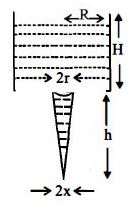
 Consider a water jar of radius $R$ that has water filled up to height $H$ and is kept on a stand of height $h$ (see figure) . Through a hole of radius $r$  $(r << R)$ at its bottom, the water leaks out and the stream of water coming down towards the ground has a shape like a funnel as shown in the figure. If the radius of the cross-section of water stream when it hits the ground is $x.$ Then
Different points in earth are at slightly different distances from the sun and hence experience different forces due to gravitation. For a rigid body, we know that if various forces act at various points in it, the resultant motion is as if a net force acts on the $c.m. ($centre of mass$)$ causing translation and a net torque at the $c.m.$ causing rotation around an axis through the $c.m.$ For the earthsun system $($approximating the earth as a uniform density sphere$).$
A constant force acts on a body. Which of the following correctly represents the variation of the power $P$ developed with time $t$?