MCQ
The unit of coefficient of viscosity is
  • the pascal-second
  • B
    the pascal
  • C
    the poise-second
  • D
    both (A) and (C).

Answer

Correct option: A.
the pascal-second
the pascal-second

Need a full question paper?

Generate a complete, print-ready paper with questions like this in minutes — across 16+ boards, with answer keys.

Start Generating Free

Similar questions

A body is said to be opaque to the radiation if ( $a, r$ and $t$ are coefficient of absorption, reflection and transmission respectively)
When radiation of wavelength ' $\lambda$ ' is incident on a metallic surface, the stopping potential is $4.8 V$. If the surface is illuminated with radiation of double the wavelength then the stopping potential becomes $1.6 V$. The threshold wavelength for the surface is
A gas at N.T.P. is suddenly compressed to $\left(\frac{1}{4}\right)^{ th }$ of its original volume. The final pressure in (Given $\gamma=$ ratio of specific heats $=\frac{3}{2}$ ) atmosphere is ( $P=$ original pressure)
At constant temperature, increasing the pressure of a gas by $5 \%$ its volume will decrease by
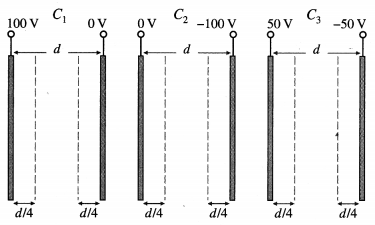
The figure shows three capacitors $C_1 C_2$ and $C_3$. The dashed lines are equipotential surfaces within each capacitor. In which of the capacitors is the po. between the two equipotentials $\Delta V =50 V$ ?

Image

A simple harmonic oscillator has an amplitude $A$ and period $T$. The time required by the oscillator to cover the distance from $x = A$ to $x =\frac{A}{2}$ is
A circuit of negligible resistance has an inductor of $0.16 H$ and capacitor of $25 \mu F$ connected in series with an alternating voltage source. The resonating frequency of the circuit is
In a biprism experiment, keeping the experimental setup unchanged, the fringe width
A solid metallic sphere has a charge $+3 Q$. Concentric with this sphere is a conducting spherical shell having charge $-Q$. The radius of the sphere is ' $A$ ' and that of the spherical shell is ' $B$ ' $(B>A)$. The electric field at a distance 'R' (A < R < B) from the center is $\left(\varepsilon_0=\right.$ permittivity of vacuum $)$