MCQ
The unit of percentage error is
  • A
    Same as that of physical quantity
  • B
    Different from that of physical quantity
  • Percentage error is unit less
  • D
    Errors have got their own units which are different from that of physical quantity measured

Answer

Correct option: C.
Percentage error is unit less
c
$\%$ error $=\left(\frac{\text { measused }-\text { exact value }}{\text { exact value }} \times 100\right)$

Her, we are talking about ratio of same unit so from here we cansaly that - error is uniture.

Need a full question paper?

Generate a complete, print-ready paper with questions like this in minutes — across 16+ boards, with answer keys.
Start Generating Free

Similar questions

Two metal spheres have radil $r$ and $2 r$ and they emit thermal radiation with maximum intensities at wavelengths $\lambda$ and $2 \lambda$ respectively. The respective ratio of the radiant energy emitted by them per second will be .........
If the time period $(T)$ of vibration of a liquid drop depends on surface tension $(S)$, radius $(r)$ of the drop and density $(\rho )$ of the liquid, then the expression of $T$ is
If we study the vibration of a pipe open at both ends, then the following statement is not true.
A substance of mass $m\, kg$ requires a power input of $P$ watts to remain in the molten state at its melting point. When the power is turned off, the sample completely solidifies in time $t$ sec. What is the latent heat of fusion of the substance
If wavelength of a wave is $\lambda = 6000Å.$ Then wave number will be
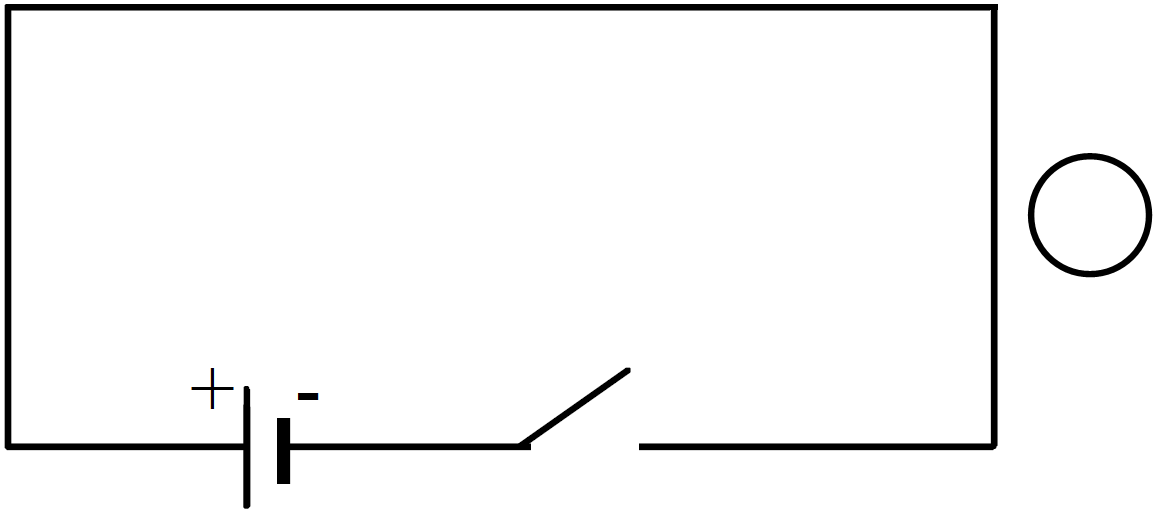
Consider the situation shown in figure. If the switch is closed and after some time it is opened again, the closed loop will show:
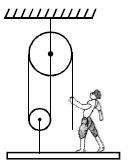
A man of mass $60\ kg$ is standing on a platform of mass $40\ kg$ as shown in figure then what force man should apply on rope so that he accelerate up with the platform with acceleration of $2\ m/s^2$ ............ $N$
A particle moving along $x-$axis has acceleration $f$, at time $t$ , given by $ f=f_0$$\left( {1 - \frac{t}{T}} \right)$, where $f_0$ and $T$ are constants. The particle at $t=0$ has zero velocity . In the time interval between $t=0$ and the instant when $f=0$ , the particle 's velocity $(v_x)$ is 
Two identical balls $A$ and $B$ are released from the positions shown in figure. They collide elastically on horizontal portion $MN$ . The ratio of the heights attained by $A$ and $B$ after collision will be : (neglect friction)
Time taken by an object falling from rest to cover the height of ${h_1}$ and ${h_2}$ is respectively ${t_1}$ and ${t_2}$ then the ratio of ${t_1}$ to ${t_2}$ is