MCQ
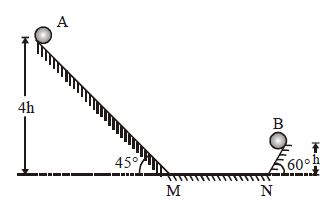
Two identical balls $A$ and $B$ are released from the positions shown in figure. They collide elastically on horizontal portion $MN$ . The ratio of the heights attained by $A$ and $B$ after collision will be : (neglect friction)
  • A
    $1 : 4$
  • B
    $2 : 1$
  • $4 : 13$
  • D
    $2 : 5$

Answer

Correct option: C.
$4 : 13$
c
When the two balls collide with each other as the mass of the two balls is equal, they exchange their velocities on colliding elasticaslly. Let the speed of the ball $\mathrm{B}$ when it reaches back ot the initial position be $v$. then

$4 m g h=\frac{1}{2} m v^{2}+m g h \Rightarrow v=\sqrt{6 g h}$

Height reached by particle $B$ (from highest point the incline)

$H_{B}=\frac{v^{2} \sin ^{2} 60^{\circ}}{2 g}=\frac{9 h}{4},$ total height $=h+\frac{9 h}{4}=\frac{13 h}{4}$

after collision the partcle $A$ reaches the maximum height $=h$

Ratio $=\frac{H_{A}}{H_{B}}=\frac{4}{13}$

Need a full question paper?

Generate a complete, print-ready paper with questions like this in minutes — across 16+ boards, with answer keys.

Start Generating Free

Similar questions

For ideal gas, which statement is not true
Two sources of sound $S_1$ and $S_2$ produce sound waves of same frequency $660\, Hz$. A listener is moving from source $S_1$ towards $S_2$ with a constant speed $u\, m/s$ and he hears $10\, beats/s$. The velocity of sound is $330\, m/s$. Then, $u$ equals ... $m/s$
The value of R in SI unit will be:
Two sound sources emitting sound each of wavelength $\lambda$ are fixed at a given distance apart. A listener moves with a velocity $u$ along the line joining the two sources. The number of beats heard by him per second is:
The dumbell is placed on a frictionless horizontal table. Sphere $A$ is attached to a frictionless pivot so that $B$ can be made to rotate about $A$ with constant angular velocity. If $B$ makes one revolution in period $P$, the tension in the rod is
A cubical block is floating in a liquid with one fourth of its volume immersed in the liquid. If whole of the system accelerates upward with acceleration $g / 4$, the fraction of volume immersed in the liquid will be ..........
The distance travelled by a particle is directly proportional to $t^{1/2}$, where $t =$ time elapsed. What is the nature of motion ?
The displacement of a particle is proportional to the cube of time elapsed. How does the acceleration of the particle depends on time obtained
silver atom in a solid oscillates in simple harmonic motion in some direction with a frequency of $10^{12}  /sec$. What is the force constant of the bonds connecting one atom with the other? ................ $\mathrm{N/m}$     (Mole wt. of silver $= 108 $ andAvagadro number $= 6.02 \times 10^{23}$ $gm \ mole^{ -1}$ )
A body of mass $2\, kg$ is situated at a height $5\, m$ above the ground. It's potential energy is reported as $70\, J$ . Potential energy of a $3\, kg$ body situated at height $1\,m$ above ground will be reported ................ $\mathrm{J}$