MCQ
The universal property among all substances is
  • A
    ferromagnetism
  • B
    non-magnetism
  • C
    diamagnetism
  • D
    paramagnetism

Answer

(c) diamagnetism
Explanation: Diamagnetism is a universal property among all substances.

Need a full question paper?

Generate a complete, print-ready paper with questions like this in minutes — across 16+ boards, with answer keys.

Start Generating Free

Similar questions

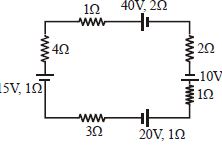
Find the current in the loop.
An astronomical refracting telescope will have large angular magnification and high angular resolution, when it has an objective lens of
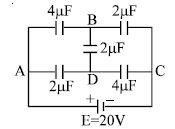
The figure shows a diagonal symmetric arrangement of capacitors and a battery. If the potential of $C$ is zero, then
A capacitor when filled with a dielectric $K = 3$ has charge ${Q_0}$, voltage ${V_0}$ and field ${E_0}$. If the dielectric is replaced with another one having $K = 9$ the new values of charge, voltage and field will be respectively
A luminous object is placed at a distance of $30 \,cm$ from the convex lens of focal length $20 \,cm$. On the other side of the lens, at what distance from the lens a convex mirror of radius of curvature $10\, cm$ be placed in order to have an upright image of the object coincident with it.....$cm$
Corpuscular theory of light was advanced by:
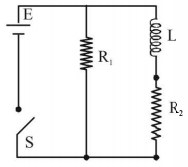
An inductor of inductance $L=400\,mH$ and resistors of resistance $R_1=2 \,\Omega$ and $R _2=2\,\Omega$ are connected to a battery of emf $12\,V$ as shown in the figure. The internal resistance of the battery is negligible. The switch $S$ is closed at $t=0$. The potential drop across $L$ as a function of time is
Magnets A and B are geometrically similar but the magnetic moment of A is twice that of B. If $T_1$ and $T_2$ be the time periods of the oscillation when their like poles and unlike poles are kept together respectively, then $\frac{T_1}{T_2}$ will be
In an $ac$ circuit $I = 100\, sin \,200$ $\pi t.$ The time required for the current to achieve its peak value will be
An electromagnetic wave, going through vacuum is described by$E=E_0 \sin (k x-\omega t)$. Which of the following is independent of wavelength