MCQ
The $V-i$ graph for a conductor makes an angle $\theta $ with $V-$ axis. Here $ V$ denotes the voltage and $i$ denotes current. The resistance of conductor is given by
  • A
    $\sin \theta $
  • B
    $\cos \theta $
  • C
    $\tan \theta $
  • $\cot \theta $

Answer

Correct option: D.
$\cot \theta $
d
At an instant approach the student will choose $\tan\,\theta$ will be the right answer. But it is to be seen here the curve makes the angle $\theta$ with the $V-$ axis. So it makes an angle $(90 -\theta)$ with the $i-$ axis.

So resistance $=$ slope $= \tan \,(90 -\theta) = \cot\,\theta$.

Need a full question paper?

Generate a complete, print-ready paper with questions like this in minutes — across 16+ boards, with answer keys.
Start Generating Free

Similar questions

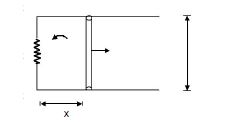
Two long parallel horizontal rails, a distance $l$ apart and each has a resistance $\lambda$ per  unit length are joined at one end by a resistance $R$. A perfectly conducting rod $MN$ of mass  $m$ is free to slide along the rails without friction. There is a uniform magnetic field of  induction $B$ normal to the plane of paper and directed into the paper. A variable force $F$ is applied to the rod $MN$ such that, as the rod moves, a constant current $i$ flows through $P$. The applied force $F$ as function of distance $x$ of the rod from $R$ is


A cube of a metal is given a positive charge $Q$. For the above system, which of the following statements is true
The current in a triode at anode potential $100\,V$ and grid potential $-1.2 \,V is 7.5 \,mA$. If grid potential is changed to $ -2.2\, V$, the current becomes $5.5\, mA$. the value of trans conductance (gm) will be....$mili\, mho$
Which of these is a fusion reaction
In the ideal double-slit experiment, when a glass-plate (refractive index 1.5) of thickness t is introduced in the path of one of the interfering beams (wavelength l), the intensity at the position where the central maximum occurred previously remains unchanged. The minimum thickness of the glass-plate is 
In a charge free region, electric field lines can be taken to be continuous curves:
Nuclear fission experiments show that the neutrons split the uranium nuclei into two fragments of about same size. This process is accompanied by the emission of several
A conducting sphere of radius $R$ is given a charge $Q$. The electric potential and the electric field at the centre of the sphere respectively are
Charges $4Q$, $q$ and $Q$ and placed along $x$-axis at positions $x = 0,x = l/2$ and $x = l$, respectively. Find the value of $q$ so that force on charge $Q$ is zero
In oscillating LC circuit, the total stored energy is $U$ and maximum charge upon capacitor is $Q$. When the charge upon the capacitor is $\frac{Q}{2}$, the energy stored in the inductor is