MCQ
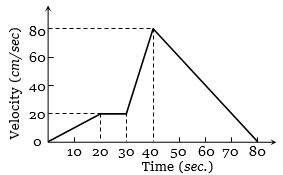
The $v - t$ graph of a moving object is given in figure. The maximum acceleration is...........$\mathrm{cm/sec}^{2}$
  • A
    $1$
  • B
    $2$
  • C
    $3$
  • $6$

Answer

Correct option: D.
$6$
d
(d) Maximum acceleration means maximum change in velocity in minimum time interval.

In time interval $t = 30$ to $t = 40\,sec $

$a = \frac{{\Delta v}}{{\Delta t}} = \frac{{80 - 20}}{{40 - 30}} = \frac{{60}}{{10}} = 6\;cm/{\sec ^2}$

Need a full question paper?

Generate a complete, print-ready paper with questions like this in minutes — across 16+ boards, with answer keys.
Start Generating Free

Similar questions

When two particles collide elastically, then impulsive force can't change
An iron block is dropped into a deep well. Sound of splash is heard after $4.23 \,s$. If the depth of the well is $78.4 \,m$, then find the speed of sound in air is ............ $m / s$ $\left(g=9.8 \,m / s ^2\right)$
A liquid boils when its vapour pressure is equal to:
At a given temperature the $r.m.s.$ velocity of molecules of the gas is
The displacement time graph of a particle executing S.H.M. is shown in Fig.Which of the following statement is/ are true?
  1. The force is zero at $\text{t}=\frac{3\text{T}}{4}.$
  2. The acceleration is maximum at $\text{t}=\frac{4\text{T}}{4}.$
  3. The velocity is maximum at $\text{t}=\frac{\text{T}}{4}.$
  4. The P.E. is equal to K.E. of oscillation at $\text{t}=\frac{\text{T}}{4}.$
A body is moving along a circular path. How much work is done by the centripetal force?
If $\vec A,\vec B$ and $\vec C$ are vectors having a unit magnitude. If $\vec A + \vec B + \vec C = \vec 0$ then $\vec A.\vec B + \vec B.\vec C + \vec C.\vec A$ will be 
If energy $(E)$, velocity $(v)$and force $(F)$ be taken as fundamental quantity, then what are the dimensions of mass
A mass $m$ moving horizontally (along the $x-$ axis) with velocity $v$ collides and sticks to a mass of $3\,m$ moving vertically upward (along the $y-$axis) with velocity $2v.$ The final velocity of the combination is
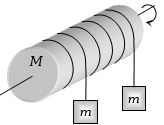
A uniform solid cylinder of mass $M$ and radius $R$ rotates about a frictionless horizontal axle. Two similar masses suspended with the help two ropes wrapped around the cylinder. If the system is released from rest then the acceleration of each mass will be