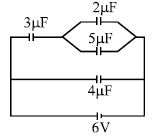
In the circuit shown in figure, the ratio of charges on $5\ \mu F$ and $4\ \mu F$ capacitor is :
Medium
Download our app for free and get started
$P . D .$ across $5 \mu F V_{1}=\frac{3}{10} \times 6=1.8 V$
$Q_{5 \mu F}=5 \mu F \times 1.8 V=9 \mu C$
$Q_{4 \mu F}=4 \mu F \times 6 V=24 \mu C$
$\frac{Q_{5 \mu F}}{Q_{4 \mu F}}=\frac{9 \mu C}{24 \mu C}=\frac{3}{8}$

Download our appand get started for free
Experience the future of education. Simply download our apps or reach out to us for more information. Let's shape the future of learning together!No signup needed.*
Similar Questions
- 1Two identical electric point dipoles have dipole moments $\overrightarrow{p}_{1}= p\hat i$ and $\overrightarrow{p}_{2}=- p\hat i$ and are held on the $x-$axis at distance $'a'$ from each other. When released, they move along the $x-$axis with the direction of their dipole moments remaining unchanged. If the mass of each dipole is $'m',$ their speed when they arc infinitely far apart isView Solution
- 2View SolutionA parallel plate capacitor is charged to a certain potential and the charging battery is then disconnected. Now, if the plates of the capacitor are moved apart then:
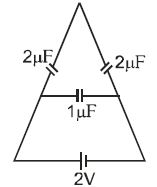
- 3The charge (in $\mu C$) on any one of the $2\,\mu F$ capacitor and $1\,\mu F$capacitor will be given respectively asView Solution
- 4If a slab of insulating material $4 \times {10^{ - 3}}\,m$ thick is introduced between the plates of a parallel plate capacitor, the separation between plates has to be increased by $3.5 \times {10^{ - 3}}\,m$ to restore the capacity to original value. The dielectric constant of the material will beView Solution
- 5View SolutionOne plate of parallel plate capacitor is smaller than other, then charge on smaller plate will be
- 6A parallel plate capacitor has capacitance $C$. If it is equally filled with parallel layers of materials of dielectric constants $K_1$ and $K_2$ its capacity becomes $C_1$. The ratio of $C_1$ to $C$ isView Solution
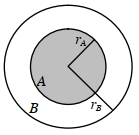
- 7In the figure, the inner (shaded) region $A$ represents a sphere of radius $r_A=1$, within which the electrostatic charge density varies with the radial distance $r$ from the center as $\rho_A=k r$, where $k$ is positive. In the spherical shell $B$ of outer radius $r_B$, the electrostatic charge density varies as $\rho_{\bar{B}}=\frac{2 k}{r}$. Assume that dimensions are taken care of. All physical quantities are in their $SI$ units.View Solution
Which of the following statement($s$) is(are) correct?
- 8The distance between the plates of a parallel plate condenser is $\,4mm$ and potential difference is $60\;volts$. If the distance between the plates is increased to $12\,mm$, thenView Solution
- 9Two parallel plate condensers of capacity of $20 \mu F$ and $30 \mu F$ are charged to the potentials of $30V$ and $20V$ respectively. If likely charged plates are connected together then the common potential difference will be :-......$V$View Solution
- 10Three concentric spherical shells have radii $a, b$ and $c (a < b < c)$ and have surface charge densities $\sigma ,-\;\sigma $ and $\;\sigma \;$ respectively. If $V_A,V_B$ and $V_C$ denote the potentials of the three shells, then, for $c = a +b,$ we haveView Solution