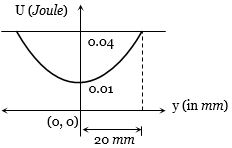
The variation of potential energy of harmonic oscillator is as shown in figure. The spring constant is
Medium


Download our appand get started for free
Experience the future of education. Simply download our apps or reach out to us for more information. Let's shape the future of learning together!No signup needed.*
Similar Questions
- 1A pendulum has time period $T$ in air. When it is made to oscillate in water, it acquired a time period $T' = \sqrt 2 T$. The density of the pendulum bob is equal to (density of water $= 1$)View Solution
- 2A disc of radius $R$ and mass $M$ is pivoted at the rim and is set for small oscillations. If simple pendulum has to have the same period as that of the disc, the length of the simple pendulum should beView Solution
- 3View SolutionA pendulum is swinging in an elevator. Its period will be greatest when the elevator is
- 4$x$ and $y$ displacements of a particle are given as $x(t) = a\,sin\,\omega t$ and $y(t) = a\,sin\,2\omega t.$ Its trajectory will look likeView Solution
- 5Which of the following expressions corresponds to simple harmonic motion along a straight line, where $x$ is the displacement and $a, b, c$ are positive constants?View Solution
- 6A wooden cube (density of wood $'d'$ ) of side $'l'$ floats in a liquid of density $'\rho '$ with its upper and lower surfaces horizontal. If the cube is pushed slightly down and released, it performs simple harmonic motion of period $'T'$. Then, $'T'$ is equal toView Solution
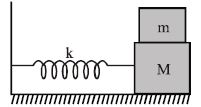
- 7In the arrangement, spring constant $k$ has value $2\,N\,m^{-1}$ , mass $M = 3\,kg$ and mass $m = 1\,kg$ . Mass $M$ is in contact with a smooth surface. The coefficient of friction between two blocks is $0.1$ . The time period of $SHM$ executed by the system isView Solution
- 8If $x = a\sin \left( {\omega t + \frac{\pi }{6}} \right)$ and $x' = a\cos \omega t$, then what is the phase difference between the two wavesView Solution
- 9A particle executes simple harmonic motion along a straight line with an amplitude $A$. The potential energy is maximum when the displacement isView Solution
- 10An object of mass $m$ is suspended at the end of a massless wire of length $L$ and area of cross$-$section, $A$. Young modulus of the material of the wire is $Y$. If the mass is pulled down slightly its frequency of oscillation along the vertical direction isView Solution