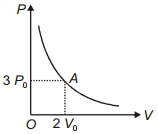
The variation of pressure $P$ with volume $V$ for an ideal monatomic gas during an adiabatic process is shown in figure. At point $A$ the magnitude of rate of change of pressure with volume is
Diffcult
Download our app for free and get started
(d)
$P V^y=$ constant
$P \propto V^{-\gamma}$
$\frac{d P}{P}=-\gamma \frac{d V}{V}$
$\frac{d P}{d V}=\gamma \frac{P}{V}$
$=\frac{5}{3} \times \frac{3 P_0}{2 V_0}$
$=\frac{5 P_0}{2 V_0}$
Then $\left(\frac{d P}{d V}\right)=\frac{5 P_0}{2 V_0}$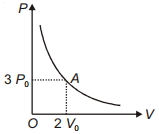

Download our appand get started for free
Experience the future of education. Simply download our apps or reach out to us for more information. Let's shape the future of learning together!No signup needed.*
Similar Questions
- 1A Carnot's engine working between $400\, K$ and $800\, K$ has a work output of $1200\, J$ per cycle. The amount of heat energy supplied to the engine from the source in each cycle is ........... $J$View Solution
- 2A gas expands under constant pressure $P$ from volume ${V_1}$ to ${V_2}$. The work done by the gas isView Solution
- 3A Carnot engine takes $3 \times {10^6}\,cal$. of heat from a reservoir at $627°C$, and gives it to a sink at $27°C.$ The work done by the engine isView Solution
- 4One mole of ${O_2}$ gas having a volume equal to $22.4$ litres at ${0^o}C$ and $1$ atmospheric pressure in compressed isothermally so that its volume reduces to $11.2$ litres. The work done in this process is ...... $J$View Solution
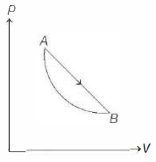
- 5An ideal gas is made to undergo a cycle depicted by the $p-V$ diagram given below. The curved line from $A$ to $B$ is an adiabat.Then,View Solution
- 6At $N.T.P.$ one mole of diatomic gas is compressed adiabatically to half of its volume $\gamma = 1.41$. The work done on gas will be ....... $J$View Solution
- 7View SolutionIf a cylinder containing a gas at high pressure explodes, the gas undergoes
- 8View SolutionA cycle tyre bursts suddenly. This represents an
- 9Consider two containers $A$ and $B$ containing monoatomic gases at the same Pressure $(P)$, Volume $(V)$ and Temperature $(T)$. The gas in $A$ is compressed isothermally to $\frac{1}{8}$ of its original volume while the gas $B$ is compressed adiabatically to $\frac{1}{8}$ of its original volume. The ratio of final pressure of gas in $B$ to that of gas in $A$ is ...........View Solution
- 10View SolutionAn ideal gas undergoes a cyclic process as shown in diagram. The net work done by the gas in the cycle is