MCQ
The velocity of a particle performing simple harmonic motion, when it passes through its mean position is
  • A
    Infinity
  • B
    Zero
  • C
    Minimum
  • Maximum

Answer

Correct option: D.
Maximum
d
(d)In S.H.M. at mean position velocity is maximum
So $v = a\omega $ (maximum)

Need a full question paper?

Generate a complete, print-ready paper with questions like this in minutes — across 16+ boards, with answer keys.

Start Generating Free

Similar questions

Measure of two quantities along with the precision of respective measuring instrument is:

$\text{A} = 2.5\text{ms}^{-1} \pm 0.5\text{ms}^{-1}$

$\text{B} = 0.10\text{s} \pm 0.01\text{s}$

The value of A B will be,

  1. $(0.25 \pm 0.08)\text{m}.$

  2. $(0.25 \pm 0.5)\text{m}.$

  3. $(0.25 \pm 0.05)\text{m}.$

  4. $(0.25 \pm 0.135)\text{m}$

A car is accelerated on a leveled road and attains a velocity 4 times its initial velocity. In this process, the potential energy of the car:
An ice berg of density $900 Kg/m^3$ is floating in water of density $1000 Kg/m^3$. The percentage of volume of ice-cube outside the water is ...... $\%$
A and B are arguing about uniform acceleration. A states that acceleration means "the longer you go." B states that acceleration means "the further you go." Who is right?
The position of a particle moving in the $xy-$ plane at any time $t$ is given by $x = (3t^2 -6t)\, metres$, $y = (t^2 -2t)\,metres$. Select the correct statement about the moving particle from the following
If $7\, gm N _{2}$ is mixed with $20\, gm$ $Ar$, there $C _{ p } / C _{ v }$ of mixture will be
Work-energy theorem is valid in the presence of
The dimensions of Stefan-Boltzmann's constant $\sigma$ can be written in terms of Planck's constant $h$, Boltzmann's constant $k_B$ and the speed of light $c$ as $\sigma=h^\alpha k_B^\beta c^\gamma$. Here,
If the force constant of a wire is $K,$ the work done in increasing the length of the wire by $l$ is
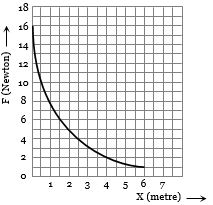
The relation between the displacement $X$  of an object produced by the application of the variable force $F$ is represented by a graph shown in the figure. If the object undergoes a displacement from $X = 0.5\,m$ to $X = 2.5\,m$ the work done will be approximately equal to .............. $J$