MCQ
The velocity of waves in a string fixed at both ends is $2 m/s$. The string forms standing waves with nodes $5.0 cm$ apart. The frequency of vibration of the string in $Hz$ is
  • A
    $40$
  • B
    $30$
  • $20$
  • D
    $10$

Answer

Correct option: C.
$20$
c
(c) Here $\frac{\lambda }{2} = 5.0\,cm\,\,$$ \Rightarrow \lambda = 10$$cm$
Hence $n = \frac{v}{\lambda } = \frac{{200}}{{10}} = 20\,Hz.$

Need a full question paper?

Generate a complete, print-ready paper with questions like this in minutes — across 16+ boards, with answer keys.
Start Generating Free

Similar questions

The conclusion of Bernoulli's theorem is:
What is the shape of the graph between the speed and kinetic energy of a body
The velocity of a bullet is reduced from $200\,m/s$ to $100\,m/s $ while travelling through a wooden block of thickness $10\,cm$. The retardation, assuming it to be uniform, will be 
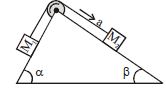
Two masses $M_1$ and $M_2$ are attached to the ends of a string which passes over a pulley attached to the top of a double inclined plane of angles of inclination $\alpha $ and $\beta $. If $M_2 > M_1$, the acceleration $a$ of the system is given by
$A$ particle moving with kinetic energy $= 3$ joule makes an elastic head on collision with a stationary particle which has twice its mass during the impact.
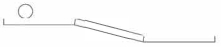
A rigid ball rolls without slipping on a surface shown below: Which one of the following is the most likely representation of the distance travelled by the ball versus time graph?
A body thrown vertically up with a velocity $'u'$ reaches the maximum height $'h'$ after $'T'$ second. The correct statement among the following is:
One quarter sector is cut from a uniform circular disc of radius $R$. This sector has mass $M$. It is made to rotate about a line perpendicular to its plane and passing through the centre of the original disc. Its moment of inertia about the axis of rotation is
Two planets have same density but different radii. The acceleration due to gravity would be ........
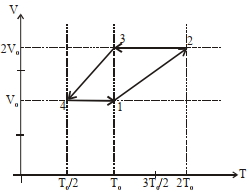
One mole of a monoatomic ideal gas goes through a thermodynamic cycle, as shown in the volume versus temperature ($V-T$) diagram. The correct statement($s$) is/are :

[ $R$ is the gas constant]

$(1)$ Work done in this thermodynamic cycle $(1 \rightarrow 2 \rightarrow 3 \rightarrow 4 \rightarrow 1)$ is $| W |=\frac{1}{2} RT _0$

$(2)$ The ratio of heat transfer during processes $1 \rightarrow 2$ and $2 \rightarrow 3$ is $\left|\frac{ Q _{1 \rightarrow 2}}{ Q _{2 \rightarrow 3}}\right|=\frac{5}{3}$

$(3)$ The above thermodynamic cycle exhibits only isochoric and adiabatic processes.

$(4)$ The ratio of heat transfer during processes $1 \rightarrow 2$ and $3 \rightarrow 4$ is $\left|\frac{Q_{U \rightarrow 2}}{Q_{3 \rightarrow 4}}\right|=\frac{1}{2}$