MCQ
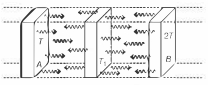
Three large identical plates are kept parallel to each other. The outer two plates are maintained at temperatures $T$ and $2 T$, respectively. The temperature of the middle plate in steady state will be close to ........... $T$
  • A
    $1.1$
  • B
    $1.3$
  • $1.7$
  • D
    $1.9$

Answer

Correct option: C.
$1.7$
c
$(c)$ Plates does not touch each other, so exchange of heat takes place in form of radiations.

In steady state, heat gained by middle plate $=$ heat lost by it.

$\Rightarrow$ Heat radiations from plate $A+$ Heat radiations from plate $B=$ Heat radiations emitted from both surfaces

$\Rightarrow A \varepsilon \sigma T^{4}+A \varepsilon \sigma(2 T)^{4}=2 A \varepsilon \sigma\left(T_{1}\right)^{4}$

$\Rightarrow \quad T^{4}+2^{4} T^{4}=2 T_{1}^{4} \Rightarrow \frac{17}{2} T^{4}=T_{1}^{4}$

$\Rightarrow \quad T_{1}^{4}=\left(\frac{17}{2}\right)^{\frac{1}{4}} \cdot T \text { or } T_{1}=1.7 T$

Need a full question paper?

Generate a complete, print-ready paper with questions like this in minutes — across 16+ boards, with answer keys.

Start Generating Free

Similar questions

A specially designed Vernier calliper has the main scale least count of $1 \,mm$. On the Vernier scale, there are $10$ equal divisions and they match with $11$ main scale divisions. Then, the least count of the Vernier calliper is ........... $mm$
Force on current carrying loop (Radius $= R$ ) in uniform magnetic $(B)$ field which is at an angle $30^{\circ}$ with the normal will be
A simple pendulum hangs from the ceiling of a car. If the car accelerates with a uniform acceleration, the frequency of the simple pendulum will
When liquid medicine of density $\rho$ is to be put in the eye, it is done with the help of a dropper. As the bulb on the top of the dropper is pressed, a drop forms at the opening of the dropper. We wish to estimate the size of the drop. We first assume that the drop formed at the opening is spherical because that requires a minimum increase in its surface energy. To determine the size, we calculate the net vertical force due to the surface tension $T$ when the radius of the drop is $\mathrm{R}$. When the force becomes smaller than the weight of the drop, the drop gets detached from the dropper.

$1.$ If the radius of the opening of the dropper is $\mathrm{r}$, the vertical force due to the surface tension on the drop of radius $R$ (assuming $\mathrm{r} \ll R$ ) is

$(A)$ $2 \pi r T$ $(B)$ $2 \pi R T$ $(C)$ $\frac{2 \pi r^2 T}{R}$ $(D)$ $\frac{2 \pi R^2 T}{r}$

$2.$ If $\mathrm{r}=5 \times 10^{-4} \mathrm{~m}, \rho=10^3 \mathrm{~kg} \mathrm{~m}^{-3}, \mathrm{~g}=10 \mathrm{~m} / \mathrm{s}^2, \mathrm{~T}=0.11 \mathrm{Nm}^{-1}$, the radius of the drop when it detaches from the dropper is approximately

$(A)$ $1.4 \times 10^{-3} \mathrm{~m}$ $(B)$ $3.3 \times 10^{-3} \mathrm{~m}$

$(C)$ $2.0 \times 10^{-3} \mathrm{~m}$ $(D)$ $4.1 \times 10^{-3} \mathrm{~m}$

$3.$ After the drop detaches, its surface energy is

$(A)$ $1.4 \times 10^{-6} \mathrm{~J}$ $(B)$ $2.7 \times 10^{-6} \mathrm{~J}$

$(C)$ $5.4 \times 10^{-6} \mathrm{~J}$ $(D)$ $8.1 \times 10^{-6} \mathrm{~J}$

Give the answer question $1,2$ and $3.$
Three capillaries of length $L, \frac{L}{2}$ and $\frac{L}{3}$ are connected in series. Their radii are $r, \frac{r}{2}$ and $\frac{r}{3}$ respectively. Then if stream-line flow is to be maintained and the pressure across the first capillary is $P$, then ............
A metal ball of surface area $200\;c{m^2}$ and temperature ${527^o}C$ is surrounded by a vessel at ${27^o}C$. If the emissivity of the metal is $0.4$ , then the rate of loss of heat from the ball is .......... $joules $ approx. $(\sigma = 5.67 \times {10^{ - 8}}J/{m^2}\; - s - {k^4})$
When a rubber-band is stretched by a distance $x$, it exerts restoring force of magnitude  $F=ax+bx^2$ where $a$ and $b$ areconstants. The work done in stretching the unstretched rubber-band by $L$ is
When milk is churned, cream gets separated due to
According to Curie's law, the magnetic susceptibility of a substance at an absolute temperature $T$ is proportional to
The velocity at the maximum height of a projectile is half of its initial velocity $u$. Its range on the horizontal plane is