Question 13 Marks
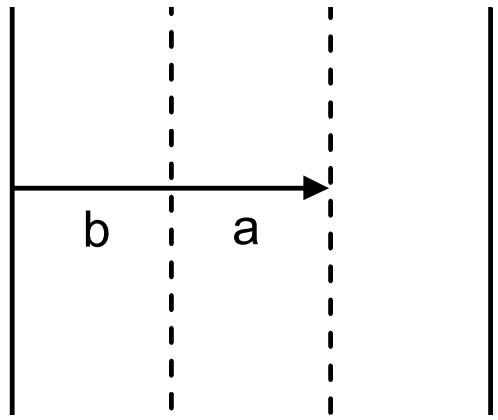
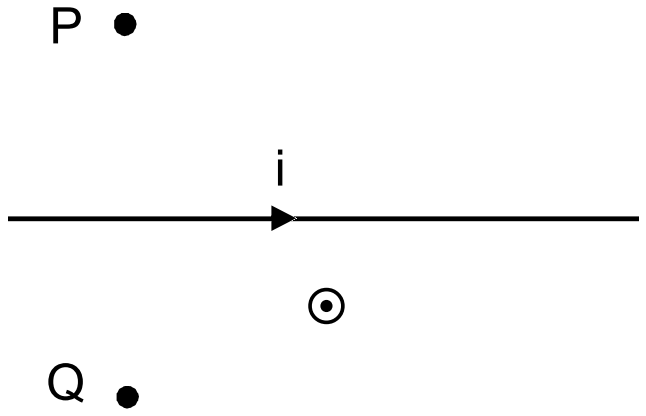
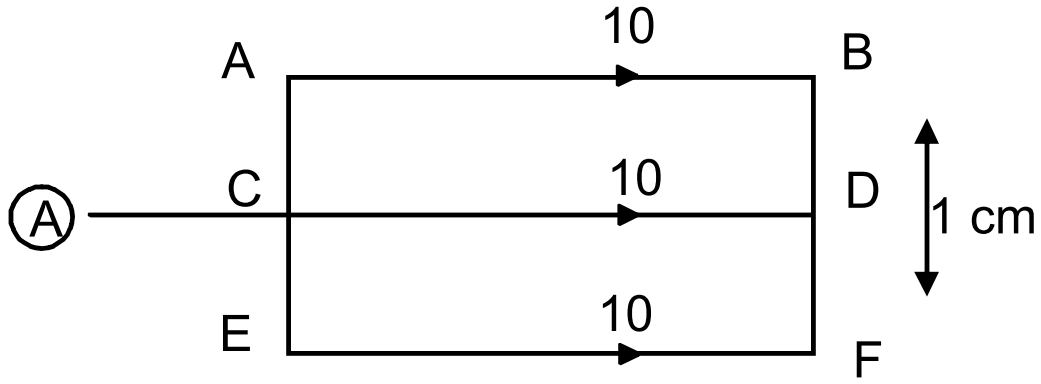
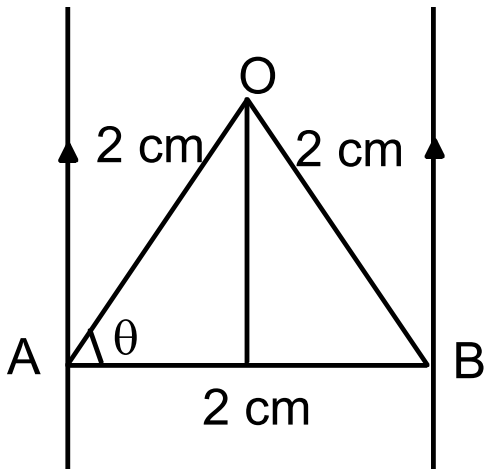
Consider the situation of the previous problem. A particle having charge q and mass m is projected from the point Q in a direction going into the plane of the diagram. It is found to describe a circle of radius r between the two plates. Find the speed of the charged particle.
Answer
View full question & answer→Charge = q,
mass = m
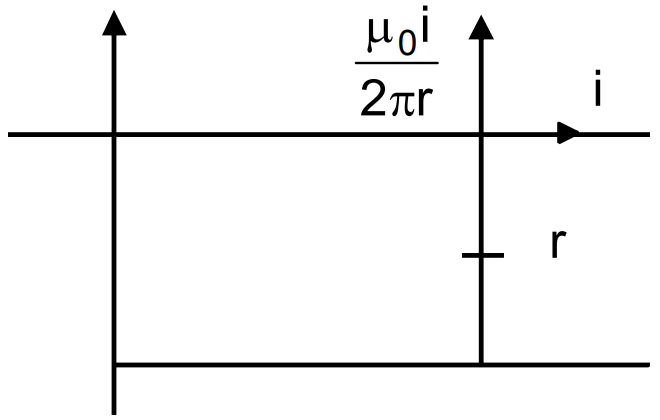
We know radius described by a charged particle in a magnetic field B.
$\text{r}=\frac{\text{mv}}{\text{qB}}$
$\text{Bit}\ \text{B}=\mu_0\text{K}$ [according to Ampere’s circuital law, where K is a constant]
$\text{r}=\frac{\text{mv}}{\text{q}\mu_0\text{K}}\Rightarrow\text{v}=\frac{\text{rq}\mu_0\text{K}}{\text{m}}$
mass = m
We know radius described by a charged particle in a magnetic field B.
$\text{r}=\frac{\text{mv}}{\text{qB}}$
$\text{Bit}\ \text{B}=\mu_0\text{K}$ [according to Ampere’s circuital law, where K is a constant]
$\text{r}=\frac{\text{mv}}{\text{q}\mu_0\text{K}}\Rightarrow\text{v}=\frac{\text{rq}\mu_0\text{K}}{\text{m}}$