Question
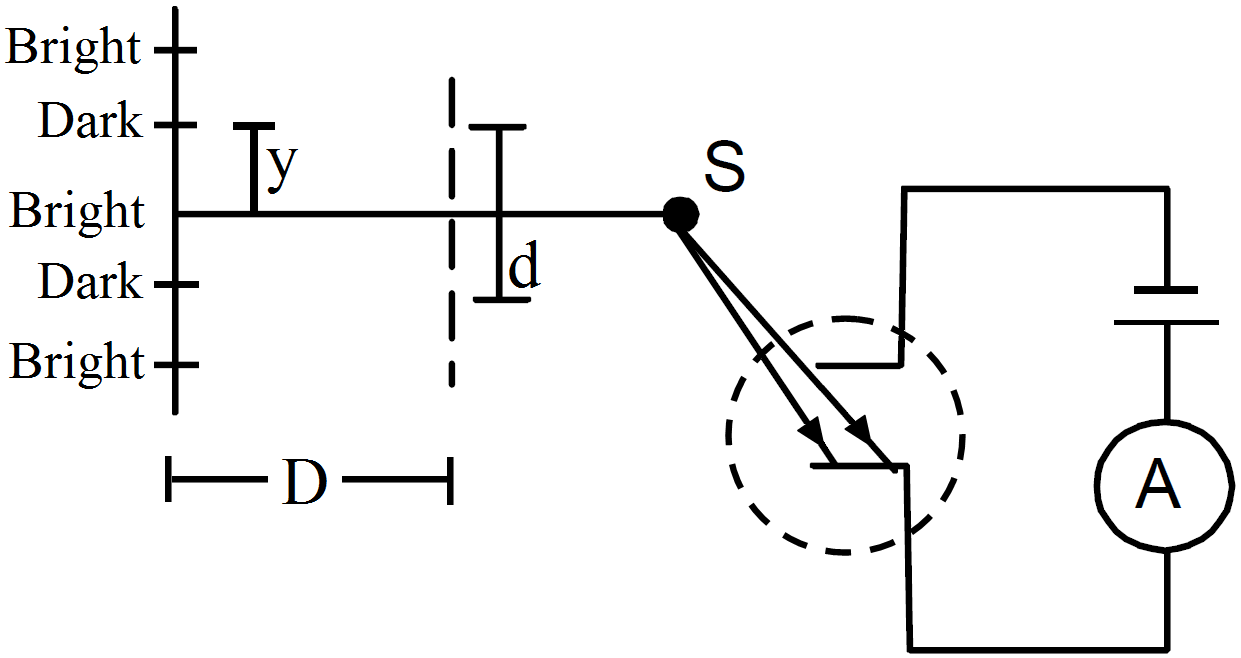
The work function of a photoelectric material is 4.0eV.
  1. What is the threshold wavelength?
  2. Find the wavelength of light for which the stopping potential is 2.5V.
Answer

$\phi=4\text{ev}=4\times1.6\times10^{-19}\text{J}$
  1. Threshold wavelength $=\lambda$
$\phi=\frac{\text{hc}}{\lambda}$

$\Rightarrow\lambda=\frac{\text{hc}}{\phi}=\frac{6.63\times10^{-13}\times3\times10^8}{4\times1.6\times10^{-19}}$

$=\frac{6.63\times2}{6.4}\times\frac{10^{-27}}{10^{-9}}=3.1\times10^{-7}\text{m}=310\text{nm}.$
  1. Stopping potential is 2.5V
$\text{E}=\phi+\text{eV}$

$\Rightarrow\frac{\text{hc}}{\lambda}=4\times1.6\times10^{-19}+1.6\times10^{-19}\times2.5$

$\Rightarrow\lambda=\frac{6.63\times10^{-34}\times3\times10^8}{\lambda\times1.6\times10^{-19}}=4+2.5$

$\Rightarrow\frac{6.63\times10^{-34}\times3\times10^8}{\lambda\times1.6\times10^{-19}\times6.5}=1.9125\times10^{-7}=190\text{nm.}$

Need a full question paper?

Generate a complete, print-ready paper with questions like this in minutes — across 16+ boards, with answer keys.

Start Generating Free

Similar questions

Establish an expression for the mean kinetic energy of molecules. Under what circumstances can this be known?
A ball is thrown vertically upwards with a velocity of 20m/ s from the top of a building of height 25m from the ground,
  1. How high will the ball reach?
  2. How long will it take for the ball to reach the ground?
  3. Trace the trajectory of motion of this ball.
A solenoid of length $20cm$, area of cross-section $4.0cm^2$ and having $4000$ turns is placed inside another solenoid of $2000$ turns having a cross-sectional area $8.0cm^2$​​​​​​​ and length $10cm$. Find the mutual inductance between the solenoids.
The molecules of a given mass of a gas have root mean square speeds of 1 $100ms− at 27C ^\circ$ and $1.00$ atmospheric pressure. What will be the root mean square speeds of the molecules of the gas at $127^\circ C$ and $2.0$ atmospheric pressure?
A block of mass m is kept over another block of mass M and the system rests on a horizontal surface figure. A constant horizontal force F acting on the lower block produces an acceleration $\frac{\text{F}}{2(\text{m+M})}$ in the system, the two blocks always move together.
  1. Find the coefficient of kinetic friction between the bigger block and the horizontal surface.
  2. Find the frictional force acting on the smaller block.
  3. Find the work done by the force of friction on the smaller block by the bigger block during a displacement d of the system.
What is meant by thermal radiation? What is the nature of thermal radiation? Explain.
Determine the position of the centre of mass of a hemisphere of radius R.
In an experiment with Foucault's apparatus, the various distances used are as follows:
Distance between the rotating and the fixed mirror = 16m
Distance between the lens and the rotating mirror = 6m
Distance between the source and the lens = 2m
When the mirror is rotated at a speed of 356 revolutions per second, the image shifts by 0.7mm. Calculate the speed of light from these data.
Demonstrate free forced and resonant oscillations.
In the arrangement shown in figure $y = 1.0mm. d = 0.24mm$ end $D = 1.2m$. The work function of the materiel of the emitter is $2.2eV$. Find the stopping potential V needed to stop the photocurrent.