Question
The work function of caesium is 2.14 eV . Find
(a) The threshold frequency for caesium.
(b) The wavelength of incident light if photocurrent is brought to zero by a stopping potential of $0.60 V .\left( h =6.625 \times 10^{-34} Js \right)$
Answer


$
\begin{array}{c}
\varphi_0=2.14 eV \\
V_0=0.60 V \\
v_0=? \\
\lambda=?
\end{array}
$
→ (a)The cut off or threshold frequency
$
\begin{array}{l}
\varphi_0=h v_0 \\
\therefore v_0=\frac{\phi_0}{h} \\
=\frac{2.14 \times 1.6 \times 10^{-19}}{6.625 \times 10^{-34}} \\
v_0=0.5163 \times 10^{15} Hz \\
v_0=5.16 \times 10^{14} Hz
\end{array}
$
→ (b) Einstein's photoelectric equation is
$\begin{array}{l} K _{\max }=h v-\varphi_0 \\ \text { but } K _{\max }=e V_0 \\ \therefore e V_0=\frac{h c}{\lambda}-\varphi_0( C =v \lambda) \\ \therefore \frac{h c}{\lambda}=e V_0+\varphi_0 \\ \therefore \frac{h c}{\lambda}=\left(1.6 \times 10^{-19} \times 0.60\right)+\left(2.14 \times 1.6 \times 10^{-19}\right) \\ \therefore \frac{h c}{\lambda}=1.6 \times 10^{-19}(0.60+2.14)\end{array}$
$\therefore \frac{h c}{\lambda}=4.384 \times 10^{-19}$
$\therefore \lambda=\frac{6.625 \times 10^{-34} \times 3 \times 10^8}{4.384 \times 10^{-19}}$
$\begin{array}{l}\therefore \lambda=4.54 \times 10^{-7} m \\ =454 \times 10^{-9} m \\ \lambda=454 nm\end{array}$

Need a full question paper?

Generate a complete, print-ready paper with questions like this in minutes — across 16+ boards, with answer keys.

Start Generating Free

Similar questions

2g of hydrogen is sealed in a vessel of volume 0.02m3 and is maintained at 300K. Calculate the pressure in the vessel.
Estimate the proportion of boron impurity whieh will increase the conductivity of a pure silicon sample by a factor of 100. Assume that each boron atom creates a hole and the concentration of holes in pure silicon at the same temperature is 7 × 10¹⁵ holes per cubic metre. Density of silicon is 5 × 10²¹ atoms per cubic metre.
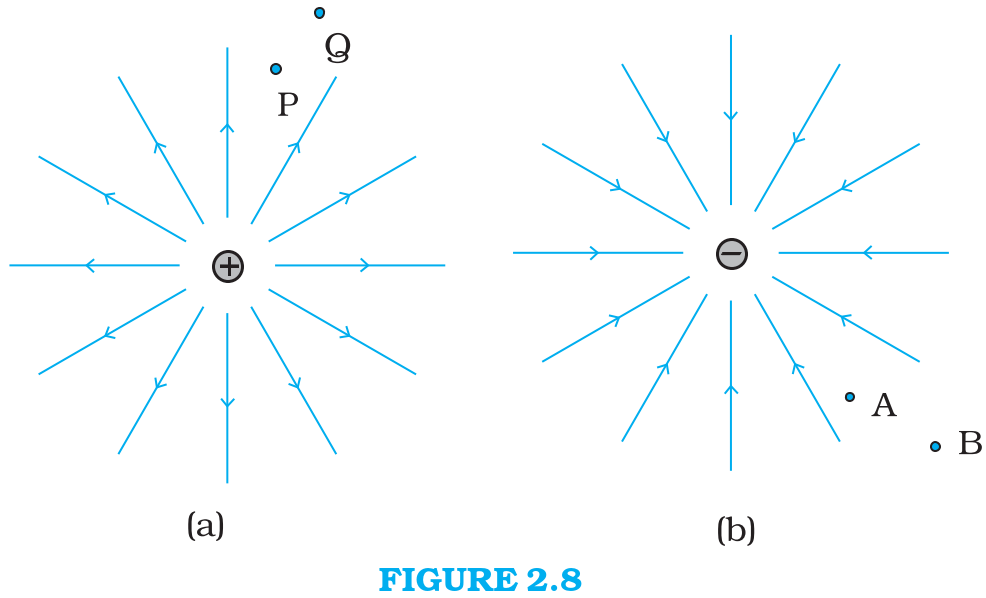
Figures 2.8 (a) and (b) show the field lines of a positive and negative point charge respectively.
Image
(a) Give the signs of the potential difference $V_{ P }-V_{ Q } ; V_{ B }-V_{ A }$.
(b) Give the sign of the potential energy difference of a small negative charge between the points $O$ and $P ; A$ and $B$.
(c) Give the sign of the work done by the field in moving a small positive charge from $Q$ to $P$.
(d) Give the sign of the work done by the external agency in moving a small negative charge from $B$ to $A$.
(e) Does the kinetic energy of a small negative charge increase or decrease in going from $B$ to $A$ ?
The work function for a certain metal is 4.2 eV. Will this metal give photoelectric emission for incident radiation of wavelength 330 nm?
A candle flame 1.6cm high is imaged in a ball bearing of diameter 0.4cm. If the ball bearing is 20cm away from the flame, find the location and the height of the image.
A 3cm tall object is placed at a distance of 7.5cm from a convex mirror of focal length 6cm. Find the location, size and nature of the image.
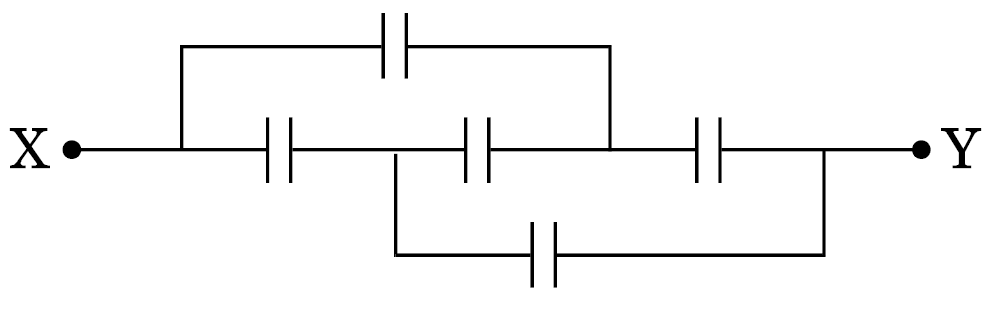
Find the equivalent capacitance of the network shown in the figure, when each capacitor is of $1\mu\text{F}$. When the ends X and Y are connected to a 6 V battery, find out (i) The charge and (ii) The energy stored in the network.
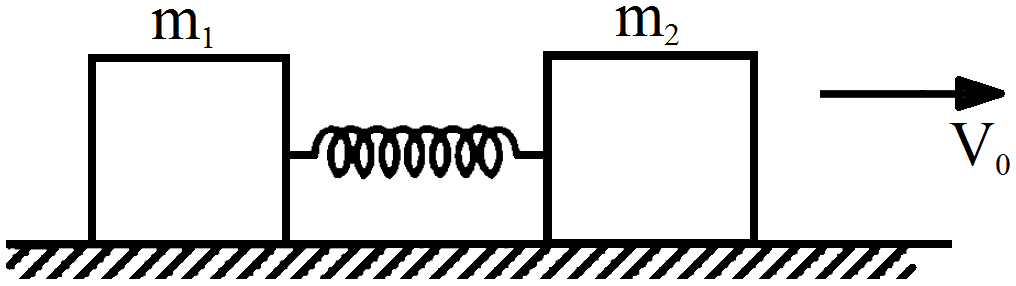
Two blocks of masses m1 and m2 are connected by a spring of spring constant k. The block of mass m2 is given a sharp impulse so that it acquires a velocity v0 towards right. Find
  1. The velocity of the centre of mass.
  2. The maximum elongation that the spring will suffer.
​​​​​​​
How does Maxwell modify Ampere's circuital law? Explain.
Is the motion of a charge across junction momentum conserving? Why or why not?