Correct option: D.$-\frac{\sqrt{3}}{32} \pi^2 \mathrm{~cm} / \mathrm{s}^2$
d
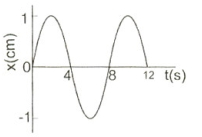
The correct option is $D -\frac{\sqrt{3} \pi^2}{32} cm / s ^2$ From the $x-t$ graph of the particle,
At, $t =0$, the particle is at $x =0$.
Hence, the particle is starting $SHM$ from its mean position.
The equation of $SHM$ of particle will be, $x=A \sin \omega t$ $\qquad$
From the graph, one oscillation has been completed in time, $T =8 s$ and maximum displacement, $A=1 cm$
So, angular frequency, $\omega=\frac{2 \pi}{T}=\frac{2 \pi}{8}=\frac{\pi}{4} rad / s$
On putting above data in $(1)$
$x=1 \sin \left(\frac{\pi t}{4}\right)$
At, $t=\frac{4}{3} s$
$x=1 \sin \left(\frac{\pi}{4} \times \frac{4}{3}\right)=\frac{\sqrt{3}}{2} cm$
Now,
Acceleration of the particle at $t=\frac{4}{3} s$,
$a=-\omega^2 x=-\left(\frac{\pi}{4}\right)^2 \times \frac{\sqrt{3}}{2}$
$\Rightarrow a=-\frac{\sqrt{3} \pi^2}{32} cm / s ^2$