The Young's modulus of a wire is $Y.$ If the energy per unit volume is $E$, then the strain will be
Easy


Download our appand get started for free
Experience the future of education. Simply download our apps or reach out to us for more information. Let's shape the future of learning together!No signup needed.*
Similar Questions
- 1A force of ${10^3}$ newton stretches the length of a hanging wire by $1$ millimetre. The force required to stretch a wire of same material and length but having four times the diameter by $1$ millimetre isView Solution
- 2A ball falling in a lake of depth $200\, m$ shows $0.1\%$ decrease in its volume at the bottom. What is the bulk modulus of the material of the ballView Solution
- 3The work done in increasing the length of a $1$ $metre$ long wire of cross-section area $1\, mm^2$ through $1\, mm$ will be ....... $J$ $(Y = 2\times10^{11}\, Nm^{-2})$View Solution
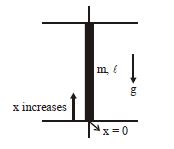
- 4A uniform dense rod with non uniform young's modulus is hanging from ceiling under gravity. If elastic energy density at every point is same then young's modulus with $x$ will change as which of the shown graphView Solution
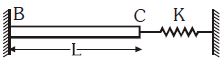
- 5A rod $BC$ of negligible mass fixed at end $B$ and connected to a spring at its natural length having spring constant $K = 10^4\ N/m$ at end $C$, as shown in figure. For the rod $BC$ length $L = 4\ m$, area of cross-section $A = 4 × 10^{-4}\ m^2$, Young's modulus $Y = 10^{11} \ N/m^2$ and coefficient of linear expansion $\alpha = 2.2 × 10^{-4} K^{-1}.$ If the rod $BC$ is cooled from temperature $100^oC$ to $0^oC,$ then find the decrease in length of rod in centimeter.(closest to the integer)View Solution
- 6View SolutionThe longitudinal strain is only possible in
- 7View SolutionThe correct increasing order for modulus of elasticity for copper, steel, glass and rubber is
- 8A $100\,m$ long wire having cross-sectional area $6.25 \times 10^{-4}\,m ^2$ and Young's modulus is $10^{10}\,Nm ^{-2}$ is subjected to a load of $250\,N$, then the elongation in the wire will be :View Solution
- 9How much force is required to produce an increase of $0.2\%$ in the length of a brass wire of diameter $0.6\, mm$ (Young’s modulus for brass = $0.9 \times {10^{11}}N/{m^2}$)View Solution
- 10A wire of length $L$ and radius $r$ is clamped at one end. If its other end is pulled by a force $F$, its length increases by $l$. If the radius of the wire and the applied force both are reduced to half of their original values keeping original length constant, the increase in length will become.View Solution