The Young's modulus of a wire of length $L$ and radius $r$ is $Y$ $N/m^2$. If the length and radius are reduced to $L/2$ and $r/2,$ then its Young's modulus will be
Easy


Download our appand get started for free
Experience the future of education. Simply download our apps or reach out to us for more information. Let's shape the future of learning together!No signup needed.*
Similar Questions
- 1Two exactly similar wires of steel and copper are stretched by equal forces. If the difference in their elongations is $0.5$ cm, the elongation $(l)$ of each wire is ${Y_s}({\rm{steel}}) = 2.0 \times {10^{11}}\,N/{m^2}$${Y_c}({\rm{copper}}) = 1.2 \times {10^{11}}\,N/{m^2}$View Solution
- 2Auniform rod rotating in gravity free region with certain constant angular velocity. The variation of tensile stress with distance $x$ from axis of rotation is best represented by which of the following graphs.View Solution
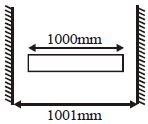
- 3$A$ rod of length $1000\, mm$ and coefficient of linear expansion $a = 10^{-4}$ per degree is placed symmetrically between fixed walls separated by $1001\, mm$. The Young’s modulus of the rod is $10^{11} N/m^2$. If the temperature is increased by $20^o C$, then the stress developed in the rod is ........... $MPa$View Solution
- 4The density and breaking stress of a wire are $6 \times$ $10^4 \mathrm{~kg} / \mathrm{m}^3$ and $1.2 \times 10^8 \mathrm{~N} / \mathrm{m}^2$ respectively. The wire is suspended from a rigid support on a planet where acceleration due to gravity is $\frac{1^{\text {rd }}}{3}$ of the value on the surface of earth. The maximum length of the wire with breaking is ............ $\mathrm{m}$ (take, $\mathrm{g}=$ $\left.10 \mathrm{~m} / \mathrm{s}^2\right)$View Solution
- 5View SolutionIf the tension on a wire is removed at once, then
- 6A force of ${10^3}$ newton stretches the length of a hanging wire by $1$ millimetre. The force required to stretch a wire of same material and length but having four times the diameter by $1$ millimetre isView Solution
- 7Young’s moduli of two wires $A$ and $B$ are in the ratio $7 : 4$. Wire $A$ is $2\, m$ long and has radius $R$. Wire $A$ is $2\, m$ long and has radius $R$. Wire $B$ is $1.5\, m$ long and has radius $2\, mm$. If the two wires stretch by the same length for a given load, then the value of $R$ is close to ......... $mm$View Solution
- 8A wire of length $2\, m$ is made from $10\;c{m^3}$ of copper. A force $F$ is applied so that its length increases by $2\, mm.$ Another wire of length 8 m is made from the same volume of copper. If the force $F$ is applied to it, its length will increase by......... $cm$View Solution
- 9The pressure of a medium is changed from $1.01 × 10^5$ $Pa$ to $1.165 × 10^5$ $Pa$ and change in volume is $10\% $ keeping temperature constant. The Bulk modulus of the medium isView Solution
- 10If the temperature of a wire of length $2 \,m$ and area of cross-section $1 \,cm ^2$ is increased from $0^{\circ} C$ to $80^{\circ} C$ and is not allowed to increase in length, then force required for it is ............$N$ $\left\{Y=10^{10} \,N / m ^2, \alpha=10^{\left.-6 /{ }^{\circ} C \right\}}\right.$View Solution