Two exactly similar wires of steel and copper are stretched by equal forces. If the difference in their elongations is $0.5$ cm, the elongation $(l)$ of each wire is ${Y_s}({\rm{steel}}) = 2.0 \times {10^{11}}\,N/{m^2}$${Y_c}({\rm{copper}}) = 1.2 \times {10^{11}}\,N/{m^2}$
Medium


Download our appand get started for free
Experience the future of education. Simply download our apps or reach out to us for more information. Let's shape the future of learning together!No signup needed.*
Similar Questions
- 1A wire elongates by $l$ $mm$ when a load $W$ is hanged from it. If the wire goes over a pulley and two weights $W$ each are hung at the two ends, the elongation of the wire will be (in $mm$)View Solution
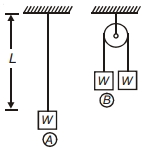
- 2If in case $A$, elongation in wire of length $L$ is $l$, then for same wire elongation in case $B$ will be ......View Solution
- 3To break a wire of one meter length, minimum $40 \,kg \,wt$. is required. Then the wire of the same material of double radius and $6 \,m$ length will require breaking weight ....... $kg \,wt$View Solution
- 4If a spring is extended to length $l,$ then according to Hook's lawView Solution
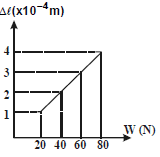
- 5The adjacent graph shows the extension $(\Delta l)$ of a wire of length $1\, m$ suspended from the top of a roof at one end and with a load $W$ connected to the other end. If the cross-sectional area of the wire is $10^{-6}\, m^2$, calculate the Young’s modulus of the material of the wire.View Solution
- 6When load of $5\,kg$ is hung on a wire then extension of $3\,m$ takes place, then work done will be ....... $joule$View Solution
- 7One end of a uniform wire of length $L$ and of weight $W$ is attached rigidly to a point in the roof and a weight ${W_1}$ is suspended from its lower end. If $S$ is the area of cross-section of the wire, the stress in the wire at a height $3L/4$ from its lower end isView Solution
- 8View SolutionMinimum and maximum values of Poisson’s ratio for a metal lies between
- 9Two exactly similar wires of steel and copper are stretched by equal forces. If the difference in their elongations is $0.5$ cm, the elongation $(l)$ of each wire is ${Y_s}({\rm{steel}}) = 2.0 \times {10^{11}}\,N/{m^2}$${Y_c}({\rm{copper}}) = 1.2 \times {10^{11}}\,N/{m^2}$View Solution
- 10A wire is loaded by $6\, kg$ at its one end, the increase in length is $12\, mm.$ If the radius of the wire is doubled and all other magnitudes are unchanged, then increase in length will be ......... $mm$View Solution