Question
There are energy bands in a solid. Do we have really continuous energy variation in a band or do we have very closely spaced but still discrete energy levels?

Answer

A solid consists of a combination of closely spaced energy levels. These energy levels are discrete but they have very small energy gap between two consecutive levels so they are referred as band. However, the energy levels in the band are discrete.

Need a full question paper?

Generate a complete, print-ready paper with questions like this in minutes — across 16+ boards, with answer keys.
Start Generating Free

Similar questions

In a Coolidge tube, electrons strike the target and stop inside it. Does the target get more and more negatively charged as time passes?
A thin prism is made of a material having refractive indices 1.61 and 1.65 for red and violet light. The dispersive power of the material is 0.07. It is found that a beam of yellow light passing through the prism suffers a minimum deviation of 4.0° in favourable conditions. Calculate the angle of the prism.
Calculate the fall in temperature when a gas initially at 72°C is expanded suddenly to eight times its original volume. Given y $=\frac53.(\therefore\text{V}_2=8\text{x}\text{ c.c.})$
A particle is in linear simple harmonic motion between two points A and B, 10cm apart. Take the direction from A to B as positive direction and give the signs of velocity and acceleration on the particle when it is:
  1. At the end B.
  2. At 3cm away from A going towards B.
In a typical fission reaction, the nucleus is split into two middle-weight nuclei of unequal masses. Which of the two (heavier or lighter) has greater kinetic energy? Greater linear momentum?
Give the magnitude and direction of the net force acting on
(a) A drop of rain falling down with a constant speed.
(b) A cork of mass 10 g floatting on water.
(c) A kite skillfully held stationary in the sky.
(d) A car moving with a constant velocity of 30 km/h on a rough road,
(e) a high-speed electron in space far from all material objects, and free of electric and magnetic fields.
The sap in trees, which consists mainly of water in summer, rises in a system of capillaries of radius r = 2.5 × 10⁻⁵m. The surface tension of sap is T = 7.28 × 10⁻²N m-1 and the angle of contact is 0°. Does surface tension alone account for the supply of water to the top of all trees?
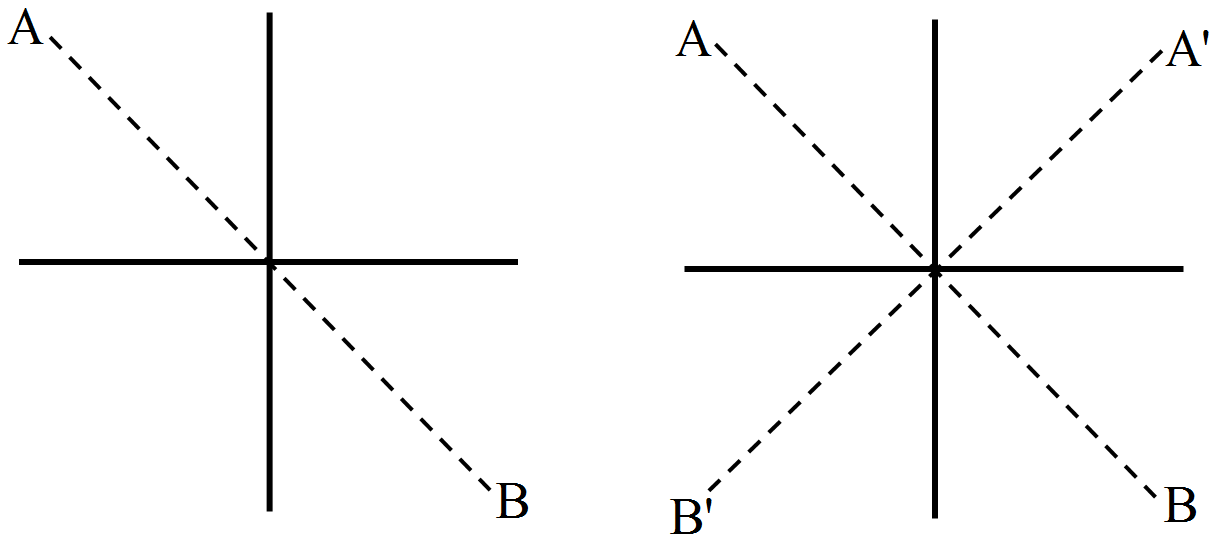
Two uniform thin identical rods, each of mass M and length L, are joined so as to form a cross as shown in Fig. What is the moment of inertia of the system about the bisector line AB?

What will be the internal energy of 8g of oxygen at STP?
An electric fan of mass 2kg falls from the ceiling of a lift moving down with uniform speed of 2ms-1. It hits the floor of the lift (length of the lift = 2m) and does not rebound. How much heat will be produced by the impact?