Question
There are many observable patterns in thephysical and chemical properties of elementsas we descend in a group or move across aperiod in the Periodic Table.Atomic Radius the determination of the atomic sizecannot be precise. In other words, there is no practical way by which the size of an individualatom can be measured. However, an estimateof the atomic size can be made by knowing thedistance between the atoms in the combinedstate. One practical approach to estimate thesize of an atom of a non-metallic element is tomeasure the distance between two atoms whenthey are bound together by a single bond in acovalent molecule and from this value, the“Covalent Radius” For metals, we define theterm “Metallic Radius” which is taken as halfthe internuclear distance separating the metalcores in the metallic crystal. Atomic Radius to refer to both covalent ormetallic radius depending on whether theelement is a non-metal or a metal. Atomic radiican be measured by X-ray or otherspectroscopic methods. The atomic size generallydecreases across a period. It is because within the period the outerelectrons are in the same valence shell and theeffective nuclear charge increases as the atomicnumber increases resulting in the increasedattraction of electrons to the nucleus.Note that the atomic radii of noble gasesAre not considered here. Being monoatomic,Their (non-bonded radii) values are very large.In fact radii of noble gases should be comparednot with the covalent radii but with the van derWaals radii of other elements. The removal of an electron from an atom resultsin the formation of a cation, whereas gain ofan electron leads to an anion. The ionic radiican be estimated by measuring the distancesbetween cations and anions in ionic crystals.In general, the ionic radii of elements exhibitthe same trend as the atomic radii. A cation issmaller than its parent atom because it hasfewer electrons while its nuclear charge remainsthe same. The size of an anion will be largerthan that of the parent atom because theaddition of one or more electrons would resultin increased repulsion among the electronsand a decrease in effective nuclear charge. When we find some atoms and ions whichcontain the same number of electrons, we callthem isoelectronic species. For example,O2–, F–, Na+ and Mg2+ have the same number ofelectrons (10). Their radii would be differentbecause of their different nuclear charges.A quantitative measure of the tendency of anelement to lose electron is given by itsIonization Enthalpy. It represents the energyrequired to remove an electron from an isolatedgaseous atom (X) in its ground state. The ionization enthalpy is expressed inunits of kJ mol–1. We can define the secondionization enthalpy as the energy required toremove the second most loosely boundelectron The first ionization enthalpies of elementshaving atomic numbers up to 60 are plotted then The periodicity of the graph is quitestriking. You will find maxima at the noble gaseswhich have closed electron shells and verystable electron configurations. On the otherhand, minima occur at the alkali metals andtheir low ionization enthalpies can be correlated with their high reactivity. In addition, you willnotice two trends the first ionization enthalpygenerally increases as we go across a periodand decreases as we descend in a group. Electron Gain Enthalpy. when an electron is added to a neutral gaseousatom (x) to convert it into a negative ion, theenthalpy change accompanying the process isdefined as the electron gain enthalpy (∆egh).Electron gain enthalpy provides a measure ofthe ease with which an atom adds an electronto form anion. electron gain enthalpies have largenegative values toward the upper right of theperiodic table preceding the noble gases.The variation in electron gain enthalpies ofelements is less systematic than for ionizationenthalpies. As a general rule, electron gainenthalpy becomes more negative with increasein the atomic number across a period. Theeffective nuclear charge increases from left toright across a period and consequently it willbe easier to add an electron to a smaller atomsince the added electron on an average wouldbe closer to the positively charged nucleus. ElectronegativityA qualitative measure of the ability of an atomin a chemical compound to attract sharedelectrons to itself is called electronegativity.Unlike ionization enthalpy and electron gainenthalpy, it is not a measureable quantity.However, a number of numerical scales ofelectronegativity of elements viz., Pauling scale,Mulliken-Jaffe scale, Allred-Rochow scale havebeen developed. The one which is the most widely used is the Pauling scale. Electronegativity generallyincreases across a period from leftto right (say from lithium tofluorine) and decrease down a group(say from fluorine to astatine) inthe periodic table. Non-metallic elements have strong tendencyto gain electrons. Therefore, electronegativityis directly related to that non-metallicproperties of elements. It can be furtherextended to say that the electronegativity isinversely related to the metallic properties of elements. Thus, the increase inelectronegativities across a period isaccompanied by an increase in non-metallicproperties (or decrease in metallic properties)of elements. Similarly, the decrease inelectronegativity down a group is accompanied by a decrease in non-metallic properties (orincrease in metallic properties) of elements.
  1. The atomic size generally  … across a period.
  1. Increases
  2. Decreases
  3. Remains Constant
  4. None of above
  1. The ionization enthalpy is expressed in units of ….
  1. kJ mol–1
  2. mole kJ-1
  3. mole kJ
  4. -kJ mol-1
  1. Which of the following is/are  numerical scales of electronegativity of elements.
  1. Pauling scale
  2. Mulliken-Jaffe scale
  3. Allred-Rochow scale
  4. All the above
  1. The … in electronegativity down a group is accompanied by a … in non-metallic properties.
  1. Increase, Decrease
  2. Decrease, Increase
  3. Decrease, Decrease
  4. Increase , Increase
  1. Electronegativity generally … across a period from left to right and … down a group in the periodic table.
  1. Increase, Decrease
  2. Decrease, Increase
  3. Decrease, Decrease
  4. Increase, Increase

Answer

  1. (b) Decreases
  1. (a) kJ mol–1
  1. (d) All the above
  1. (c) Decrease, Decrease
  1. (a) Increase, Decrease

Need a full question paper?

Generate a complete, print-ready paper with questions like this in minutes — across 16+ boards, with answer keys.

Start Generating Free

Similar questions

Read the passage given below and answer the following questions from 1 to 5.

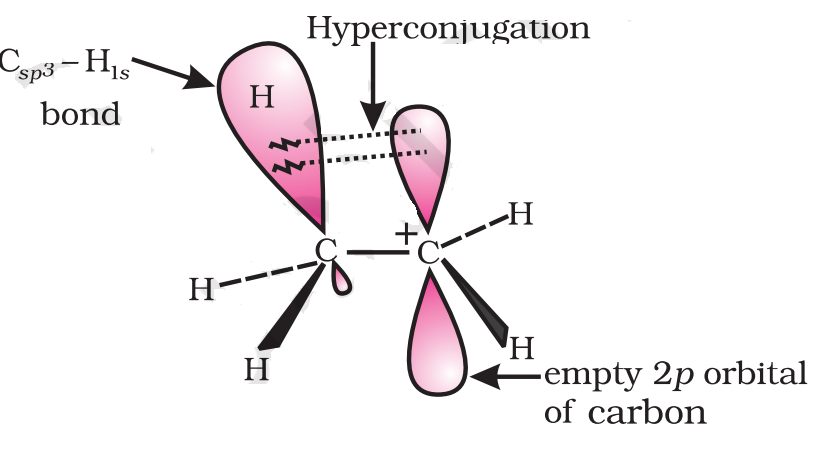
Hyperconjugation is a general stabilising interaction. It involves delocalisation of σ electrons of C—H bond of an alkyl group directly attached to an atom of unsaturated system or to an atom with an unshared p orbital. The σ electrons of C—H bond of the alkyl group enter into partial conjugation with the attached unsaturated system or with the unshared p orbital. Hyperconjugation is a permanent effect. To understand hyperconjugation effect, let us take an example of CH 32 + (ethyl cation) in which the positively charged carbon atom has an empty p orbital. One of the C-H bonds of the methyl group can align in the plane of this empty p orbital and the electrons constituting the C-H bond in plane with this p orbital can then be delocalised into the empty p orbital as depicted in Figure.

This type of overlap stabilises the carbocation because electron density from the adjacent σ bond helps in dispersing the positive charge.

In general, greater the number of alkyl groups attached to a positively charged carbon atom, the greater is the hyperconjugation interaction and stabilisation of the cation. Thus, we have the following relative stability of carbocations:

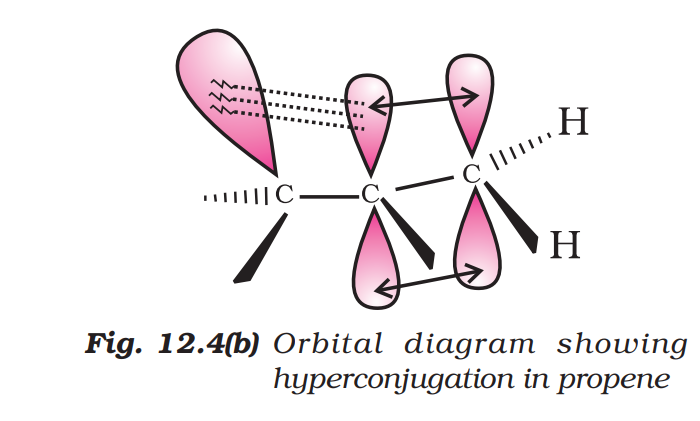
Hyperconjugation is also possible in alkenes and alkylarenes. Delocalisation of electrons by hyperconjugation in the case of alkene can be depicted as in Figure.

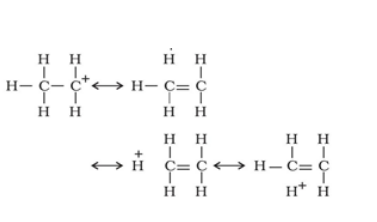
There are various ways of looking at the hyperconjugative effect. One of the way is to regard C—H bond as possessing partial ionic character due to resonance.

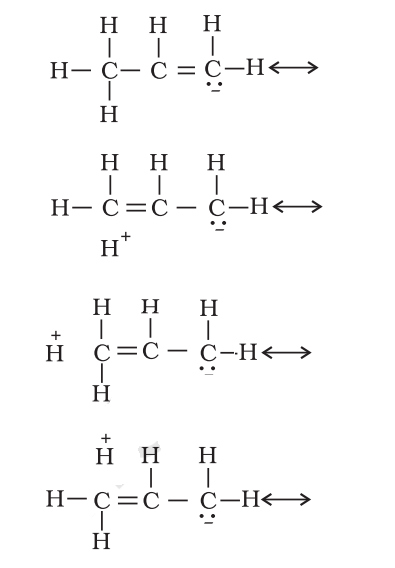
The hyperconjugation may also be regarded as no bond resonance.

The hyperconjugation may also be regarded as no bond resonance.

Methods of purification of organic compounds Once an organic compound is extracted from a natural source or synthesised in the laboratory, it is essential to purify it. Various methods used for the purification of organic compounds are based on the nature of the compound and the impurity present in it. The common techniques used for purification are as follows :

i) Sublimation

ii) Crystallisation

iii) Distillation

iv) Differential extraction and

v) Chromatography

Finally, the purity of a compound is ascertained by determining its melting or boiling point. Most of the pure compounds have sharp melting points and boiling points. New methods of checking the purity of an organic compound are based on different types of chromatographic and spectroscopic techniques.

Sublimation  On heating, some solid substances change from solid to vapour state without passing through liquid state. The purification technique based on the above principle is known as sublimation and is used to separate sublimable compounds from non- sublimable impurities.

Crystallisation This is one of the most commonly used techniques for the purification of solid organic compounds. It is based on the difference in the solubilities of the compound and the impurities in a suitable solvent. The impure compound is dissolved in a solvent in which it is sparingly soluble at room temperature but appreciably soluble at higher temperature. The solution is concentrated to get a nearly saturated solution. On cooling the solution, pure compound crystallises out and is removed by filtration. The filtrate (mother liquor) contains impurities and small quantity of the compound. If the compound is highly soluble in one solvent and very little soluble in another solvent, crystallisation can be satisfactorily carried out in a mixture of these solvents. Impurities, which impart colour to the solution are removed by adsorbing over activated charcoal. Repeated crystallisation becomes necessary for the purification of compounds containing impurities of comparable solubilities.


Distillation This important method is used to separate

i) volatile liquids from nonvolatile impurities and

ii) the liquids having sufficient difference in their boiling points.

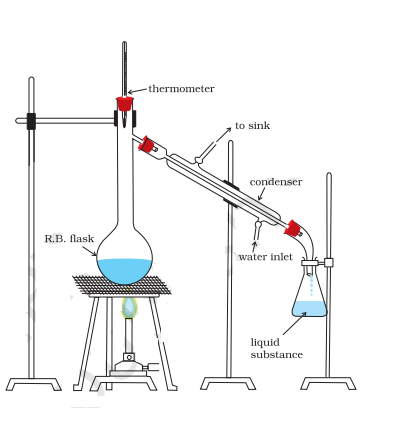
Liquids having different boiling points vaporise at different temperatures. The vapours are cooled and the liquids so formed are collected separately. Chloroform (b.p 334 K) and aniline (b.p. 457 K) are easily separated by the technique of distillation (Fig 12.5). The liquid mixture is taken in a round bottom flask and heated carefully. On boiling, the vapours of lower boiling component are formed first. The vapours are condensed by using a condenser and the liquid is collected in a receiver. The vapours of higher boiling component form later and the liquid can be collected separately.

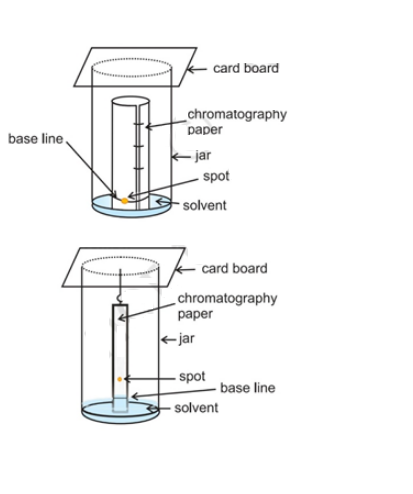
Partition Chromatography: Partition chromatography is based on continuous differential partitioning of components of a mixture between stationary and mobile phases. Paper chromatography is a type of partition chromatography. In paper chromatography, a special quality paper known as chromatography paper is used. Chromatography paper contains water trapped in it, which acts as the stationary phase. A strip of chromatography paper spotted at the base with the solution of the mixture is suspended in a suitable solvent or a mixture of solvents (Fig. 12.13). This solvent acts as the mobile phase. The solvent rises up the paper by capillary action and flows over the spot. The paper selectively retains different components according to their differing partition in the two phases. The paper strip so developed is known as a chromatogram. The spots of the separated coloured compounds are visible at different heights from the position of initial spot on the chromatogram. The spots of the separated colourless compounds may be observed either under ultraviolet light or by the use of an appropriate spray reagent as discussed under thin layer chromatography.

  1. Hyperconjunction  involves delocalisation of … electrons of C—H bond of an alkyl group directly attached to an atom of unsaturated system or to an atom with an unshared p orbital.
  1. $\sigma$
  2. $\pi$
  3. $\delta$
  4. $\eta$
  1. Which of the is an example of technique used for purification.
  1. Distillation
  2. Differential extraction
  3. Chromatography
  4. All the above
  1. On heating, some solid substances change from solid to vapour state without passing through liquid state is known as …
  1. Melting
  2. Boiling
  3. Sublimation
  4. Condensation
  1. The hyperconjugation may also be regarded as ….
  1. bonding resonance
  2. no bond resonance
  3. no bond induction
  4. bonding induction
  1. Chromatography paper contains water trapped in it, which acts as the … phase.
  1. mobile
  2. stationery
  3. Secondary
  4. quaternary
Read the passage given below and answer the following questions from (i) to (iii).

Le Chatelier’s principle is also known as the equilibrium law, used to predict the effect of change on a system at chemical equilibrium. This principle states that equilibrium adjusts the forward and backward reactions in such a way as to accept the change affecting the equilibrium condition. When factor-like concentration, pressure, temperature, inert gas that affect equilibrium are changed, the equilibrium will shift in that direction where the effects caused by these changes are nullified. This principle is also used to manipulate reversible reactions in order to obtain suitable outcomes.

  1. Which one of the following conditions will favour the maximum formation of the product in the reaction?

$\text{A}_{2(\text{g})}+\text{B}_{2(\text{g})}\rightleftharpoons\text{X}_{2(\text{g})},\triangle_\text{r}\text{H}=-\text{XkJ}?$

  1. Low temperature and high pressure.
  2. Low temperature and low pressure.
  3. High temperature and high pressure.
  4. High temperature and low pressure.
  1. For the reversible reaction, 

$\text{N}_{2(\text{g})}+3\text{H}_{2(\text{g})}\rightleftharpoons2\text{NH}_{3(\text{g})}+\text{heat}$

The equilibrium shifts in forwarding direction

  1. By increasing the concentration of NH3(g)
  2. By decreasing the pressure.
  3. By decreasing the concentrations of N2(g) and H2(g)
  4. By increasing pressure and decreasing temperature.
  1. In which one of the following equilibria will the point of equilibrium shift to left when the pressure of the system is increased?
  1. $\text{H}_{2(\text{g})}+\text{l}_{2(\text{g})}\rightleftharpoons2\text{HI}_{(\text{g})}$

  2. $2\text{NH}_{3(\text{g})}\rightleftharpoons\text{N}_{2(\text{g})}+3\text{H}_{2(\text{g})}$

  3. $\text{C}_{(\text{s})}+\text{O}_{2(\text{g})}\rightleftharpoons\text{CO}_{2{\text{g}}}$

  4. $2\text{H}_{2(\text{g})}+\text{O}_{2(\text{g})}\rightleftharpoons2\text{H}_2\text{O}_{(\text{g})}$

Read the passage given below and answer the following questions from 1 to 5.

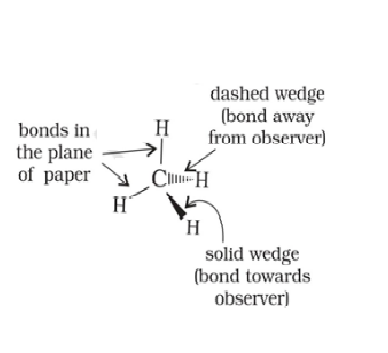
The three-dimensional (3-D) structure of organic molecules can be represented on paper by using certain conventions. For example, by using solid ( ) and dashed ( ) wedge formula, the 3-D image of a molecule from a two-dimensional picture can be perceived. In these formulas the solid-wedge is used to indicate a bond projecting out of the plane of paper, towards the observer. The dashed-wedge is used to depict the bond projecting out of the plane of the paper and away from the observer. Wedges are shown in such a way that the broad end of the wedge is towards the observer. The bonds lying in plane of the paper are depicted by using a normal line (—). 3-D representation of methane molecule on paper has been shown in Figure.

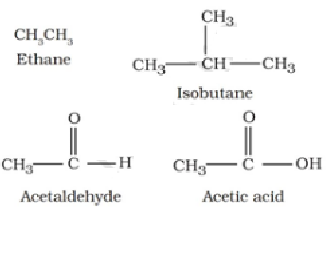
A cyclic or open chain componds these compounds are also called as aliphatic componds and consist of staright or branched chain componds for example:

Cyclic or closed chain or ring compounds

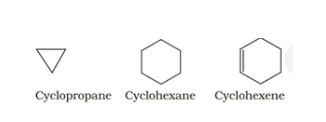
a) Alicyclic compounds Alicyclic (aliphatic cyclic) compounds contain carbon atoms joined in the form of a ring (homocyclic).

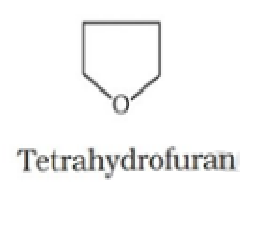
Someetimes atoms other than carbon are also present in the ring (heterocylic). Tetrahydrofuran given below is an example of this types of compound:

These exhibit some of the properties similar to those of aliphatic compounds.

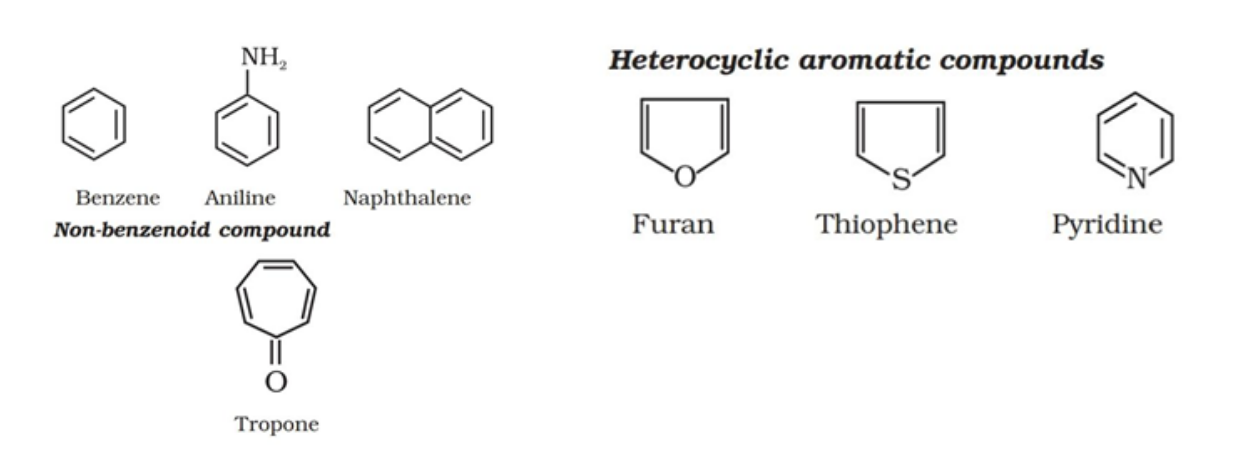
b) Aromatic compounds Aromatic compounds are special types of compounds. These include benzene and other related ring compounds (benzenoid). Like alicyclic compounds, aromatic comounds may also have hetero atom in the ring. Such compounds are called hetrocyclic aromatic compounds. Some of the examples of various types of aromatic compounds are:

Benzenoid aromatic compounds .

Organic compounds can also be classified on the basis of functional groups, into families or homologous series.

Functional Group The functional group is an atom or a group of atoms joined to the carbon chain which is responsible for the characteristic chemical properties of the organic compounds. The examples are hydroxyl group (–OH), aldehyde group (–CHO) and carboxylic acid group (–COOH) etc.

Homologous Series A group or a series of organic compounds each containing a characteristic functional group forms a homologous series and the members of the series are called homologues. The members of a homologous series can be represented by general molecular formula and the successive members differ from each other in molecular formula by a –CH2 unit. There are a number of homologous series of organic compounds. Some of these are alkanes, alkenes, alkynes, haloalkanes, alkanols, alkanals, alkanones, alkanoic acids, amines etc. It is also possible that a compound contains two or more identical or different functional groups. This gives rise to polyfunctional compounds.

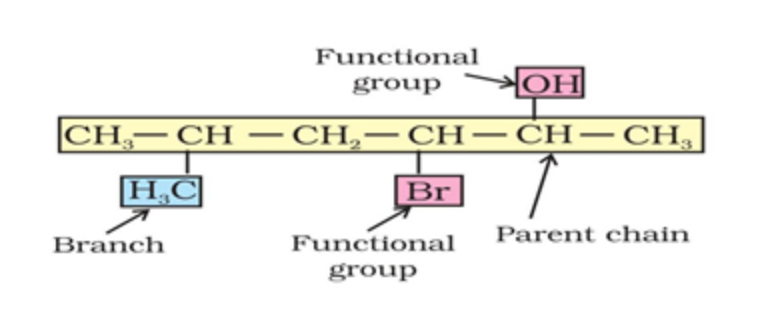
A systematic name of an organic compound is generally derived by identifying the parent hydrocarbon and the functional group(s) attached to it. See the example given below.

By further using prefixes and suffixes, the parent name can be modified to obtain the actual name. Compounds containing carbon and hydrogen only are called hydrocarbons. A hydrocarbon is termed saturated if it contains only carbon-carbon single bonds.

The IUPAC name for a homologous series of such compounds is alkane. Paraffin (Latin: little affinity) was the earlier name given to these compounds. Unsaturated hydrocarbons are those, which contain at least one carbon- carbon double or triple bond. IUPAC Nomenclature of Alkanes Straight chain hydrocarbons: The names of such compounds are based on their chain structure, and end with suffix ‘-ane’ and carry a prefix indicating the number of carbon atoms present in the chain (except from CH4 to C4H10, where the prefixes are derived from trivial names). The IUPAC names of some straight chain saturated hydrocarbons are given in Table. The alkanes in table differ from each other by merely the number of – CH2 groups in the chain. They are homologues of alkane series.

NameMolecular formulaNameMolecular Formula
MethaneCH4HeptaneC7H16
EthaneC2H6OctaneC8H18
PropaneC3H8NonaneC9H20
ButaneC4H10DecaneC10H22
PentaneC5H12IcosaneC20H42
HexaneC6H14TriacontaneC30H62
  1. IUPAC is an acronym for …
  1. International Union of Pure and Applied Chemistry
  2. International units of proteins and carbohydrates
  3. International understandings on physical aspects of chemistry
  4. Iodine under packings
  1. In homologous series,  the successive members differ from each other in molecular formula by a … unit.
  1. CH3
  2. CH2
  3. CH
  4. CH4
  1. A hydrocarbon is termed saturated if it contains only carbon-carbon … bonds.
  1. Triple
  2. Double
  3. Single
  4. Zero
  1. From ….., where the prefixes are derived from… trivial names.
  1. CH4 to C2H6
  2. CH4 to C3H8
  3. CH4 to C6H14
  4. CH4 to C4H10
  1. Molecular formula of octane is …
  1. C4H10
  2. C6H14
  3. C2H6
  4. C8H18
Read the passage given below and answer the following questions from (i) to (v).
When covalent bond is formed betweentwo similar atoms, for example in H2,O2, Cl2,N2Or F2, the shared pair of electrons is equally Attracted by the two atoms. As a result electronPair is situated exactly between the twoIdentical nuclei. The bond so formed is calledNonpolar covalent bond. As a result of polarisation, the moleculePossesses the dipole moment which can be defined as the productOf the magnitude of the charge and theDistance between the centres of positive andNegative charge. It is usually designated by aGreek letter ‘µ’. Mathematically, it is expressedAs follows :Dipole moment (µ) = charge (Q) × distance ofSeparationDipole moment is usually expressed inDebye units (D). The conversion factor is1 D = 3.33564×10⁻³⁰ C mWhere C is coulomb and m is meter. Just as all the covalent bonds haveSome partial ionic character, the ionicBonds also have partial covalentCharacter. The partial covalent character of ionic bonds was discussed by Fajans in terms of the following rules:
  • The smaller the size of the cation and theLarger the size of the anion, the greater theCovalent character of an ionic bond.
  • The greater the charge on the cation, theGreater the covalent character of the ionic bond.
  • For cations of the same size and charge,The one, with electronic configuration(n-1)d0ns0, typical of transition metals, isMore polarising than the one with a nobleGas configuration, ns2 np6, typical of alkali and alkaline earth metal cations.
Sidgwick and Powell in 1940, proposed a simple theoryBased on the repulsive interactions of theElectron pairs in the valence shell of the atoms.It was further developed and redefined byNyholm and Gillespie (1957).The main postulates of VSEPR theory areAs follows:
  • The shape of a molecule depends uponThe number of valence shell electron pairs(bonded or nonbonded) around the centralAtom.
  • Pairs of electrons in the valence shell repelone another since their electron clouds arenegatively charged.
  • These pairs of electrons tend to occupySuch positions in space that minimiseRepulsion and thus maximise distanceBetween them.
  • The valence shell is taken as a sphere withThe electron pairs localising on theSpherical surface at maximum distanceFrom one another.
  • A multiple bond is treated as if it is a singleElectron pair and the two or three electronPairs of a multiple bond are treated as aSingle super pair.
  • Where two or more resonance structuresCan represent a molecule, the VSEPRModel is applicable to any such structure.
The arrangement of electron pairs and the atoms around the central atom can be : linear,Trigonal planar, tetrahedral, trigonal-Bipyramidal and octahedral. Valence bond theory was introduced byHeitler and London (1927) and developedFurther by Pauling and others. A discussionOf the valence bond theory is based on the knowledge of atomic orbitals, electronicConfigurations of elements.partialmerging of atomic orbitals is called overlappingof atomic orbitals which results in the pairingof electrons. The extent of overlap decides thestrength of a covalent bond. according toorbital overlap concept, the formation of acovalent bond between two atoms results bypairing of electrons present in the valence shellhaving opposite spins. When orbitals of two atoms come close to formbond, their overlap may be positive, negativeor zero depending upon the sign anddirection of orientation of amplitude of orbitalwave function in space. Positive andnegative sign on boundary surface diagramsin the show the sign (phase) of orbitalwave function and are not related to charge.Orbitals forming bond should have same sign(phase) and orientation in space. This is calledpositive overlap. The criterion of overlap, as the main factorfor the formation of covalent bonds appliesuniformly to the homonuclear/heteronucleardiatomic molecules and polyatomic molecules.
  1. Dipole moment is usually expressed in….
  1. Debye
  2. Centimeter
  3. Columbs
  4. Ergs
  1. 1D = .....
  1. 33564×10–28Cm
  2. 3.3564×10⁻³⁰Cm
  3. 33564×10–32Cm
  4. 33564×10–34Cm
  1. Valence bond theory was introduced by ….
  1. Pauling and lewis
  2. Nyholm and Gillespie
  3. Heitler and London
  4. Sidgwick and Powell
  1. Pair is situated exactly between the two Identical nuclei the bond so formed is called …. covalent bond.
  1. Unipolar
  2. Bipolar
  3. Polar
  4. Nonpolar
  1. Pairs of electrons in the valence shell … one another since their electron clouds are negatively charged.
  1. Attract
  2. Repel
  3. Both a) & b)
  4. None if above
The ionic character of metallic halides tends toward covalent nature as per Fajan's rule. Such covalent halides behave as non-metal in their higher oxidation states. The property to hydrolyse to give oxy-acids of the element and corresponding hydro halogen acid for most non-metallic elements proceeds exceptionally in the way, keeping oxidation number of element and halide sam in oxo-acids.
Non-polar halides are immiscible in water, as they do not show hydrolysis, but halides of some elements with empty d-orbital undergo hydrolysis. Stability of halides of the higher state is governed by the inert-pair effect.

1. How does halide undergo hydrolysis to give oxy-acids of underlined element $PCl _3$ ? (1)
2. Out of $NCl _3$ and $BCl _3$ undergoes hydrolysis to form oxy-acids? Write the chemical reaction for the correct answer. (1)
3. Out of $PbCl _4, PbF _4, PbI _4$ and $PbBr _4$ which one doesn't exist? (2)
OR
Non-Polar halides are immiscible in water. Why? (2)

The orbital wave function or $\psi$ for an electronin an atom has no physical meaning. It issimply a mathematical function of thecoordinates of the electron. However, fordifferent orbitals the plots of correspondingwave functions as a function of r (the distancefrom the nucleus) are different. According to the German physicist, MaxBorn, the square of the wave function(i.e.,$\psi^2$) at a point gives the probability densityof the electron at that point. Boundary surface diagrams of constantprobability density for different orbitals give afairly good representation of the shapes of theorbitals. In this representation, a boundarysurface or contour surface is drawn in spacefor an orbital on which the value of probabilitydensity $\mid\psi\mid2$ is constant. In principle manysuch boundary surfaces may be possible.However, for a given orbital, only thatboundary surface diagram of constantprobability density* is taken to be goodrepresentation of the shape of the orbital whichencloses a region or volume in which theprobability of finding the electron is very high,say, 90%.

In hydrogen atom, electron has the same energy when it is in the2s orbital as when it is present in 2p orbital.The orbitals having the same energy are calleddegenerate. The 1s orbital in a hydrogenatom, as said earlier, corresponds to the moststable condition and is called the ground stateand an electron residing in this orbital is moststrongly held by the nucleus.

An electron inthe 2s, 2p or higher orbitals in a hydrogen atomis in excited state.The filling of electrons into the orbitals ofdifferent atoms takes place according to theaufbau principle which is based on the Pauli’sexclusion principle, the Hund’s rule ofmaximum multiplicity and the relativeenergies of the orbitals. Theaufbausprinciple states : In the ground state of theatoms, the orbitals are filled in order oftheir increasing energies. In other words,electrons first occupy the lowest energy orbitalavailable to them and enter into higher energyorbitals only after the lower energy orbitals arefilled.The number of electrons to be filled in variousorbitals is restricted by the exclusion principle,given by the Austrian scientist Wolfgang Pauli(1926). According to this principle : No twoelectrons in an atom can have the sameset of four quantum numbers. Pauliexclusion principle can also be stated as : “Onlytwo electrons may exist in the same orbitaland these electrons must have oppositespin.” This means that the two electrons canhave the same value of three quantum numbersn, l and ml, but must have the opposite spinquantum number.Hund’s Rule of Maximum Multiplicity rule deals with the filling of electrons into the orbitals belonging to the same subshell. It states : pairing ofelectrons in the orbitals belonging to thesame subshell (p, d or f) does not take placeuntil each orbital belonging to thatsubshell has got one electron each i.e., itis singly occupied.

The distribution of electrons into orbitals of anatom is called its electronic configuration.If one keeps in mind the basic rules whichgovern the filling of different atomic orbitals,the electronic configurations of different atomscan be written very easily.The electronic configuration of differentatoms can be represented in two ways. Forexample :

  1. sa pbdc…… notation
  2. Orbital diagram

  1. …at a point gives the probability density of the electron at that point.
  1. $\psi\times2$

  2. $-\psi^2$

  3. $\psi$

  4. $\psi^2$

  1. Only …. electrons may exist in the same orbital and these electrons must have opposite spin.
  1. One
  2. Two
  3. Three
  4. Four
  1. …deals with the filling of electrons into the orbitals belonging to the same subshell.
  1. Hund’s Rule of Maximum Multiplicity rule
  2. Pauli’s exclusion principle
  3. Aufbau principle
  4. Werner Heisenberg
  1. Electrons first occupy the …. energy orbital available to them and enter into … energy orbitals.
  1. Lowest, Higher
  2. Higher, Lowest
  3. Middle, Higher
  4. Higher, Middle
The molecular orbital theory is based on the principle of a linear combination of atomic orbitals. According to this approach when atomic orbitals of the atoms come closer, they undergo constructive interference as well as destructive interference giving molecular orbitals, i.e., two atomic orbitals overlap to form two molecular orbitals, one of which lies at a lower energy level (bonding molecular orbital). Each molecular orbital can hold one or two electrons in accordance with Pauli's exclusion principle and Hund's rule of maximum multiplicity.
For molecules up to $N _2$, the order of filling of orbitals is:
Image
Bond order $=\frac{1}{2}$ [bonding electrons - antibonding electrons]
Bond order gives the following information:
I. If bond order is greater than zero, the molecule/ion exists otherwise not.
II. Higher the bond order, higher is the bond dissociation energy.
III. Higher the bond order, greater is the bond stability.
IV. Higher the bond order, shorter is the bond length.

1. Arrange the following negative stabilities of $CN , CN ^{+}$and $CN ^{-}$in increasing order of bond. (1)
2. The molecular orbital theory is preferred over valence bond theory. Why? (1)
3. Ethyne is acidic in nature in comparison to ethene and ethane. Why is it so? (2)
OR
Bonding molecular orbital is lowered by a greater amount of energy than the amount by which antibonding molecular orbital is raised. Is this statement correct? (2)
The phenomenon of the existence of two or more compounds possessing the same molecular formula but different properties is known as isomerism. Such compounds are called isomers. Compounds having the same molecular formula but different structures (manners in which atoms are linked) are classified as structural isomers. Structural isomers are classified as chain isomer, position isomer, functional group isomer. Meristematic arises due to different alkyl chains on either side of the functional group in the molecule and stereoisomerism and can be classified as geometrical and optical isomerism. Hyperconjugation is a general stabilising interaction. It involves delocalisation of $\sigma$ electrons of the C-H bond of an alkyl group directly attached to an atom of an unsaturated system or to an atom with an unshared p orbital. This type of overlap stabilises the carbocation because electron density from the adjacent $\sigma$ bond helps in dispersing the positive charge.

1. Why Isopentane, pentane and Neopentane are chain isomers?
OR
Why hyperconjugation is a permanent effect?
2. The molecular formula $C _3 H _8 O$ represents which isomer?
3. What type of isomerism is shown by Methoxypropane and ethoxyethane?
The molecular orbital theory is based on the principle of a linear combination of atomic orbitals. According to this approach when atomic orbitals of the atoms come closer, they undergo constructive interference as well as destructive interference giving molecular orbitals, i.e., two atomic orbitals overlap to form two molecular orbitals, one of which lies at a lower energy level (bonding molecular orbital). Each molecular orbital can hold one or two electrons in accordance with Pauli's exclusion principle and Hund's rule of maximum multiplicity. For molecules up to $N _2$, the order of filling of orbitals is:
Image
Bond order $=\frac{1}{2}$ [bonding electrons - antibonding electrons]
Bond order gives the following information:
i. If bond order is greater than zero, the molecule/ion exists otherwise not.
ii. Higher the bond order, higher is the bond dissociation energy.
iii. Higher the bond order, greater is the bond stability.
iv. Higher the bond order, shorter is the bond length.

1. Arrange the following negative stabilities of $CN , CN ^{+}$and $CN ^{-}$in increasing order of bond.
2. The molecular orbital theory is preferred over valence bond theory. Why?
3. Ethyne is acidic in nature in comparison to ethene and ethane. Why is it so?
OR
Bonding molecular orbital is lowered by a greater amount of energy than the amount by which antibonding molecular orbital is raised. Is this statement correct?

Lewis dot structures, in general, do notrepresent the actual shapes of the molecules.In case of polyatomic ions, the net charge ispossessed by the ion as a whole and not by aparticular atom. It is, however, feasible toassign a formal charge on each atom. Theformal charge of an atom in a polyatomicmolecule or ion may be defined as thedifference between the number of valenceelectrons of that atom in an isolated or freestate and the number of electrons assignedto that atom in the Lewis structure. It isexpressed as :Generally the lowest energystructure is the one with the smallestformal charges on the atoms. The formalcharge is a factor based on a pure covalentview of bonding in which electron pairsare shared equally by neighbouring atoms. The octet rule, though useful, is not universal.It is quite useful for understanding thestructures of most of the organic compoundsand it applies mainly to the second periodelements of the periodic table. There are threetypes of exceptions to the octet rule.

  • The incomplete octet of the central atom
  • Odd-electron molecules
  • The expanded octetFrom the Kössel and Lewis treatment of theformation of an ionic bond, it follows that theformation of ionic compounds wouldprimarily depend upon:
  • The ease of formation of the positive andnegative ions from the respective neutralatoms;
  • The arrangement of the positive andnegative ions in the solid, that is, thelattice of the crystalline compound.

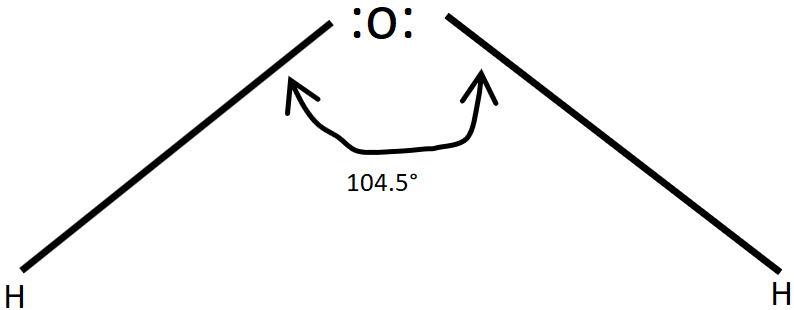
The Lattice Enthalpy of an ionic solid is defined as the energy required to completely separate one mole of a solid ionic compound into gaseous constituent ions. For example, the lattice enthalpy of NaCl is 788 kJ mol–1. This means that 788 kJ of energy is required to separate one mole of solid NaCl into one mole of Na+  (g) and one mole of Cl– (g) to an infinite distance.Bond length is defined as the equilibriumdistance between the nuclei of two bondedatoms in a molecule. Bond lengths aremeasured by spectroscopic, X-ray diffractionand electron-diffraction techniques . The covalent radius is measuredapproximately as the radius of an atom’score which is in contact with the core ofan adjacent atom in a bonded situation.  The vander Waals radius represents the overall sizeof the atom which includes its valence shellin a nonbonded situation.  Bond Angle is defined as the angle between the orbitalscontaining bonding electron pairs around thecentral atom in a molecule/complex ion. Bondangle is expressed in degree which can beexperimentally determined by spectroscopicmethods. It gives some idea regarding thedistribution of orbitals around the centralatom in a molecule/complex ion and hence ithelps us in determining its shape. Forexample H–O–H bond angle in water can berepresented as under:

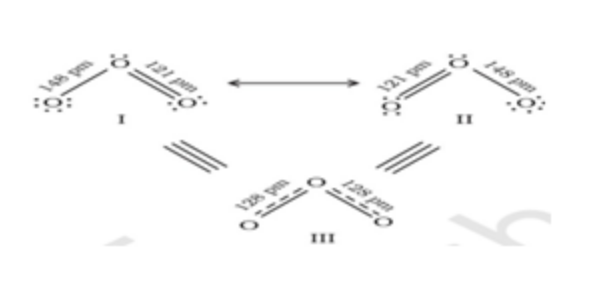
Bond Enthalpy It is defined as the amount of energy required to break one mole of bonds of a particular type between two atoms in a gaseous state. The unit of bond enthalpy is kJ mol–1. For example, the H–H bond enthalpy in hydrogen molecule is 435.8 kJ mol–1 . H2 (g) → H(g) + H(g); ∆aH  = 435.8 kJ mol–1. Bond OrderIn the Lewis description of covalent bond,the Bond Order is given by the number ofbonds between the two atoms in amolecule. The bond order, for example in H2(with a single shared electron pair), in O2(with two shared electron pairs) and in N2(with three shared electron pairs) is 1,2,3respectively. A general correlation useful forunderstanding the stablities of moleculesis that: with increase in bond order, bondenthalpy increases and bond lengthdecreases. The concept of resonance was introducedto deal with the type of difficulty experiencedin the depiction of accurate structures ofmolecules like O3. According to the conceptof resonance, whenever a single Lewis structure cannot describe a moleculeaccurately, a number of structures with similar energy, positions of nuclei, bonding and non-bonding pairs of electrons are taken as the canonical structures of the hybrid which describes the molecule accurately.

Thus for O3, the two structures shown above constitute the canonical structures or resonance structures and their hybrid i.e., theIII structure represents the structure of O3more accurately. This is also called resonance hybrid. Resonance is represented by a double headed arrow. In general, it may be stated that

  • Resonance stabilizes the molecule as the energy of the resonance hybrid is lessthan the energy of any single cannonical structure; and,
  • Resonance averages the bond characteristics as a whole. Thus the energy of theO3resonancehybrid is lower than either of the two cannonical froms I and II.
  1. Which of the following techniques used to measure bond length?
  1. Spectroscopic techniques
  2. X-ray diffraction
  3. Electron-diffraction techniques
  4. All the above
  1. The unit of bond enthalpy is …
  1. kJ mol–1
  2. Cal mol-1
  3. Cal mol
  4.  kJ mol
  1. With increase in bond order, bond enthalpy… and bond length ….
  1. Decreases, decreases
  2. Increases, decreases
  3. Increases, increases
  4. Decreases, increases
  1. The …. is measured approximately as the radius of an atom’s core which is in contact with the core of an adjacent atom in a bonded situation.
  1. Ionic radius
  2. Metallic radius
  3. Covalent radius
  4. None of above
  1. … is given by the number of bonds between the two atoms in a molecule.
  1. Bond Order
  2. Bond size
  3. Bond enthalpy
  4. Bond angle