There are three sources of sound of equal intensity with frequencies $400, 401$ and $402\, vib/sec.$ The number of beats heard per second is
Diffcult
Download our app for free and get started
(b) Let $n -1 (= 400), n (= 401)$ and $n + 1 (= 402)$ be the frequencies of the three waves.
If $a$ be the amplitude of each then $y = a\sin 2\pi (n - 1)t,$ $y = a\sin 2\pi nt$ and ${y_3} = a\sin 2\pi (n + 1)t$
Resultant displacement due to all three waves is $y = {y_1} + {y_2} + {y_3}$
$ = a\sin 2\pi nt + a\,[\sin 2\pi (n - 1)t + \sin 2\pi (n + 1)t]$
$ = a\sin 2\pi nt + a\,[2\sin 2\pi nt\cos 2\pi t]$
$\left[ {{\rm{Using }}\sin C + \sin D = 2\sin \frac{{C + C}}{2}\cos \frac{{C - D}}{2}} \right]$
==> $y = a\,(1 + \cos 2\pi t)\sin 2\pi nt$
This is the resultant wave having amplitude $ = (1 + \cos 2\pi t)$
For maximum amplitude $\cos 2\pi t = 1 ==> 2\pi t = 2m\pi \,\,$ where $m = 0, 1, 2, 3, ...$
$==> t = 0, 1, 2, 3 ...$
Hence time interval between two successive maximum is $1 sec.$ So beat frequency $= 1$
Also for minimum amplitude $(2\cos 2\pi t) = 0$
==> $\cos 2\pi t = - \frac{1}{2}$
==> $2\pi t = 2m\pi + \frac{{2\pi }}{3}$ ==> $t = + \frac{1}{3}$
==> $t = \frac{1}{3},\frac{4}{3},\frac{7}{3},\frac{{10}}{3},....$ (for $m = 0, 1, 2, ..$)
Hence time interval between two successive minima is $1 sec$ so, number of beats per second $= 1$

Download our appand get started for free
Experience the future of education. Simply download our apps or reach out to us for more information. Let's shape the future of learning together!No signup needed.*
Similar Questions
- 1View SolutionIf source and observer both are relatively at rest and if speed of sound is increased then frequency heard by observer will
- 2A car $'A'$ chasing another car $'B'$ with a speed of $20\, m/s$ sounding a horn of $180\, Hz$. While both cars are moving towards a stationary siren of frequency $170\, Hz$. What is the speed of car $B$ so that it can't hear any beat ....$m/s$ (speed of sound $= 340\, m/s$)View Solution
- 3View SolutionA closed organ pipe and an open organ pipe have their first overtones identical in frequency. Their length are in the ratio
- 4Two points on a travelling wave having frequency $500\, Hz$ and velocity $300\, m/s$ are $60^o$ out of phase, then the minimum distance between the two points is ..... $m$View Solution
- 5A string is fixed at both ends vibrates in a resonant mode with a separation $2.0 \,\,cm$ between the consecutive nodes. For the next higher resonant frequency, this separation is reduced to $1.6\,\, cm$. The length of the string is .... $cm$View Solution
- 6Two cars $A$ and $B$ are moving away from each other in opposite directions. Both the cars are moving with a speed of $20\, ms^{-1}$ with respect to the ground. If an observer in car $A$ detects a frequency $2000\, Hz$ of the sound coming from car $B$, what is the natural frequency of the sound source of car $B$ .... $Hz$ ? (speed of sound in air $= 340\, ms^{-1}$)View Solution
- 7When two sound waves travel in the same direction in a medium, the displacements of a particle located at $'x'$ at time $'t'$ is given byView Solution
${y_1} = 0.05\,\cos \,\left( {0.50\,\pi x - 100\,\pi t} \right)$
${y_2} = 0.05\,\cos \,\left( {0.46\,\pi x - 92\,\pi t} \right)$
then velocity is..... $m/s$
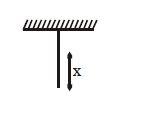
- 8A wire of variable mass per unit length $\mu = \mu _0x$ , is hanging from the ceiling as shown in figure. The length of wire is $l_0$ . A small transverse disturbance is produced at its lower end. Find the time after which the disturbance will reach to the other endsView Solution
- 9A wire of density $8 \times 10^3\,kg / m ^3$ is stretched between two clamps $0.5\,m$ apart. The extension developed in the wire is $3.2 \times 10^{-4}\,m$. If $Y =8 \times 10^{10}\,N / m ^2$, the fundamental frequency of vibration in the wire will be $......\,Hz$.View Solution
- 10When the temperature of an ideal gas is increased by $600 K$, the velocity of sound in the gas becomes $\sqrt 3 $ times the initial velocity in it. The initial temperature of the gas is .... $^oC$View Solution