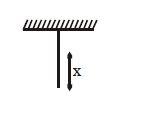
A wire of variable mass per unit length $\mu = \mu _0x$ , is hanging from the ceiling as shown in figure. The length of wire is $l_0$ . A small transverse disturbance is produced at its lower end. Find the time after which the disturbance will reach to the other ends
Diffcult
Download our app for free and get started
${\rm{m}} = \int_0^x {{\mu _0}} {\rm{xdx}} = \frac{{{\mu _0}{{\rm{x}}^2}}}{2}$
$\mathrm{v}=\sqrt{\frac{\mathrm{T}}{\mu}}=\sqrt{\frac{\mu_{0} \mathrm{x}^{2} \mathrm{g}}{2. \mu_{0} \mathrm{x}}}$
$v=\sqrt{\frac{x g}{2}}$
$a=\frac{v d v}{d x}=\sqrt{\frac{x g}{2}} \sqrt{\frac{g}{2}} \cdot \frac{1}{2 \sqrt{x}}=\frac{g}{4} \,m / s^{2}$
${l_0} = \frac{1}{2} \times \frac{{\rm{g}}}{4}{{\rm{t}}^2} \Rightarrow {\rm{t}} = \sqrt {\frac{{8{l_0}}}{{\rm{g}}}} $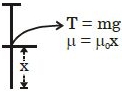

Download our appand get started for free
Experience the future of education. Simply download our apps or reach out to us for more information. Let's shape the future of learning together!No signup needed.*
Similar Questions
- 1View SolutionStanding stationary waves can be obtained in an air column even if the interfering waves are
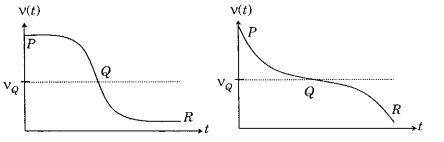
- 2Two loudspeakers $M$ and $N$ are located $20 \mathrm{~m}$ apart and emit sound at frequencies $118 \mathrm{~Hz}$ and $121 \mathrm{~Hz}$, respectively. $A$ car is initially at a point $P, 1800 \mathrm{~m}$ away from the midpoint $Q$ of the line $M N$ and moves towards $Q$ constantly at $60 \mathrm{~km} / \mathrm{hr}$ along the perpendicular bisector of $M N$. It crosses $Q$ and eventually reaches a point $R, 1800(m$ away from $Q$. Let $v(t)$ represent the beat frequency measured by a person sitting in tlie car at time $t$. Let $v_P, v_Q$ and $v_R$ be the beat frequencies measured at locations $P . Q$ and $R$, respectively. The speed of sound in air is $330 \mathrm{~m} \mathrm{~s}^{-1}$. Which of the following statement($s$) is(are) true regarding the sound heard by the person?View Solution
($A$) $v_P+v_R=2 v_Q$
($B$) The rate of change in beat frequency is maximum when the car passes through $Q$
($C$) The plot below represents schematically the variation of beat frequency with time
(image)
($D$) The plot below represents schematically the variation of beat frequency with time
(image)
- 3If the velocity of sound in air is $336 m/s$. The maximum length of a closed pipe that would produce a just audible sound will beView Solution
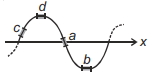
- 4Figure shows a snapshot for a travelling sine wave along a string. Four elemental portions $a, b, c$ and $d$ are indicated on the string. The elemental portion which has maximum potential energy is/areView Solution
- 5A uniform wire of length $L$ and mass $M$ is stretched between two fixed points, keeping tension $F$. A sound of frequency $m$ is impressed on it. Then the maximum vibrational energy is existing in the wire when $\mu $ =View Solution
- 6The phase difference between two points separated by $0.8 m$ in a wave of frequency is $120 Hz$ is $\frac{\pi }{2}.$ The velocity of wave is ..... $m/s$View Solution
- 7View SolutionIn a transverse wave, the particles of the medium:
- 8If $T$ is the reverberation time of an auditorium of volume $V$ thenView Solution
- 9An organ pipe ${P_1}$ closed at one end vibrating in its first overtone and another pipe ${P_2}$ open at both ends vibrating in its third overtone are in resonance with a given tuning fork. The ratio of lengths of ${P_1}$ and ${P_2}$ isView Solution
- 10View SolutionFrequency range of the audible sounds is