MCQ
There are two wire of same material and same length while the diameter of second wire is two times the diameter of first wire, then the ratio of extension produced in the wires by applying same load will be
  • A
    $1 : 1$
  • B
    $2 : 1$
  • C
    $1 : 2$
  • $4 : 1$

Answer

Correct option: D.
$4 : 1$
d
Both wires are same materials so both will have same $Young's$ modulus, and let it

be. $Y.Y = \frac{{stress}}{{strain}} = \frac{F}{{A.\left( {\Delta L/L} \right)}},$

$F = applied\,force$

$A = \,area\,of\,cross - \,section\,of\,wire$

$Now,$

${Y_1} = {Y_2} \Rightarrow \frac{{FL}}{{\left( {{A_1}} \right)\left( {\Delta {L_1}} \right)}} = \frac{{FL}}{{\left( {{A_2}} \right)\left( {\Delta {L_2}} \right)}}$

Since load and length are same for both

$ \Rightarrow r_1^2\Delta {L_1} = r_2^2\Delta {L_2},$

$\left( {\frac{{\Delta {L_1}}}{{\Delta {L_2}}}} \right) = {\left( {\frac{{{r_2}}}{{{r_1}}}} \right)^2} = 4\,\Delta {L_1}\,:\,\Delta {L_2} = 4:1$
Need a full question paper?

Generate a complete, print-ready paper with questions like this in minutes — across 16+ boards, with answer keys.

Start Generating Free

Similar questions

An Indian rubber cord $L$ metre long and area of cross-section $A$ $metr{e^2}$ is suspended vertically. Density of rubber is $D$ $kg/metr{e^3}$ and Young's modulus of rubber is $E$ $newton/metr{e^2}$. If the wire extends by $l$ metre under its own weight, then extension $l$ is
A body covers first one-third of the distance with a velocity $20\, ms^{-1}$, the second one-third with a velocity of $30\, ms^{-1}$ and last one-third with a velocity of $40\, ms^{-1}$. The average velocity is nearly........$m/s$
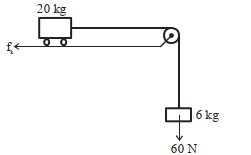
Consider a block and trolley system as shown in figure. If the coefficient of kinetic friction between the trolley and the surface is $0.04$ , the acceleration of the system in $\mathrm{ms}^{-2}$ is :

(Consider that the string is massless and unstretchable and the pulley is also massless and frictionless):

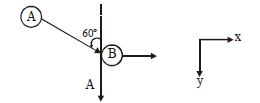
Ball $A$ moving at $12\  m/s$ collides elastically with $B$ as shown. If both balls have the same mass, what is the final velocity of ball $A$ ? ................$m/s$
Two particles $A$ and $B$ initially at rest, move towards each other, under mutual force of attraction. At an instance when the speed of $A$ is $v$ and speed of $B$ is $2v,$ the speed of centre of mass $(CM)$ is:
Density of substance at $0°C$ is $10\, gm/cc$ and at $100°C,$ its density is $9.7\, gm/cc$. The coefficient of linear expansion of the substance will be
A body of mass $1\, kg$ is under a force, which causes a displacement in it is given by $x = \frac{{{t^3}}}{3}$ (in $m$). Find the work done by the force in first second ............ $\mathrm{J}$
Consider two thermometers $T_1$ and $T_2$ of equal length, which can be used to measure temperature over the range $\theta_1$ to $\theta_2$. $T_1$ contains mercury as the thermometric liquid, while $T_2$ contains bromine. The volumes of the two liquids are the same at the temperature $\theta_1$. The volumetric coefficients of expansion of mercury and bromine are $18 \times 10^{-5} \,K ^{-1}$ and $108 \times 10^{-5} \,K ^{-1}$, respectively. The increase in length of each liquid is the same for the same increase in temperature. If the diameters of the capillary tubes of the two thermometers are $d_1$ and $d_2$, respectively. Then, the ratio of $d_1: d_2$ would be closest to
The resistance $R =\frac{ V }{ I },$ where $V =(50 \pm 2) \;V$ and $I=(20 \pm 0.2)\;A.$ The percentage error in $R$ is $x\%$. The value of $x$ to the nearest integer is .........
Three harmonic waves having equal frequency $\mathrm{v}$ and same intensity $\mathrm{I}_{0}$, have phase angles $0 , \frac{\pi}{4}$ and $-\frac{\pi}{4}$ respectively. When they are superimposed the intensity of the resultant wave is close to