There is a current of $20$ amperes in a copper wire of ${10^{ - 6}}$ square meter area of cross-section. If the number of free electrons per cubic meter is ${10^{29}}$, then the drift velocity is
Easy
Download our app for free and get started
(c) ${v_d} = \frac{i}{{nAe}} = \frac{{20}}{{{{10}^{29}} \times {{10}^{ - 6}} \times 1.6 \times {{10}^{ - 19}}}}$$ = 1.25 \times {10^{ - 3}}\,m/s$

Download our appand get started for free
Experience the future of education. Simply download our apps or reach out to us for more information. Let's shape the future of learning together!No signup needed.*
Similar Questions
- 1The current density is a solid cylindrical wire of radius $R ,$ as a function of radial distance $r$ is given by $J ( r )= J _{0}\left(1-\frac{ r }{ R }\right) .$ The total current in the radial region $r =0$ to $r =\frac{ R }{4}$ will beView Solution
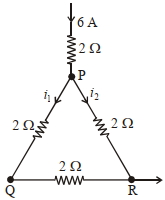
- 2A current of $6\, A$ enters one corner $P$ of an equilateral triangle $PQR$ having $3$ wires of resistance $2 \,\Omega$ each and leaves by the corner $R$. The currents $i_{1}$ in ampere is ........ .View Solution
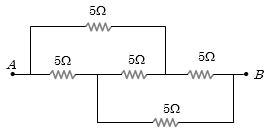
- 3Effective resistance between $A$ and $B$ is ........... $\Omega$View Solution
- 4A series combination of two resistors $1\,\Omega $ each is connected to a $12\,V$ battery of internal resistance $0.4\,\Omega $. The current flowing through it will be ............... $A$View Solution
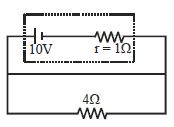
- 5Potential difference across the terminals of the battery shown in figure is .................... $V$ ($r =$ internal resistance of battery)View Solution
- 6Two electric bulbs have tungsten filament of same length. If one of them gives $60\ W$ and the other $100\ W$ , thenView Solution
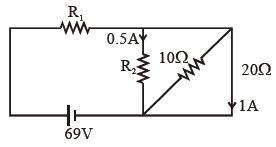
- 7In the circuit shown in the given figure the resistance $R_1$ and $R_2$ are respectivelyView Solution
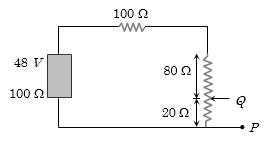
- 8In the circuit, the potential difference across $PQ$ will be nearest to .............. $V$View Solution
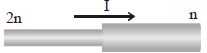
- 9Two cylindrical rods of uniform crosssection area $A$ and $2A$, having free electrons per unit volume $2n$ and $n$ respectively are joined in series. A current $I$ flows through them in steady state. Then the ratio of drift velocity of free electron in left rod to drift velocity of electron in the right rod is $\left( {\frac{{{v_L}}}{{{v_R}}}} \right)$View Solution
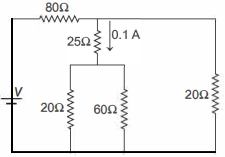
- 10A current of $0.1 \,A$ flows through a $25 \,\Omega$ resistor represented by the circuit diagram. The current in $80 \,\Omega$ resistor is ........... $A$View Solution