Two electric bulbs have tungsten filament of same length. If one of them gives $60\ W$ and the other $100\ W$ , then
Medium


Download our appand get started for free
Experience the future of education. Simply download our apps or reach out to us for more information. Let's shape the future of learning together!No signup needed.*
Similar Questions
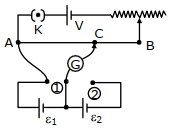
- 1In the given potentiometer circuit arrangement, the balancing length ${AC}$ is measured to be $250$ ${cm}$. When the galvanometer connection is shifted from point $(1)$ to point $(2)$ in the given diagram, the balancing length becomes $400\, {cm}$. The ratio of the emf of two cells, $\frac{\varepsilon_{1}}{\varepsilon_{2}}$ is -View Solution
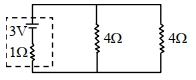
- 2View SolutionIn the given circuit, the terminal potential difference of the cell is:
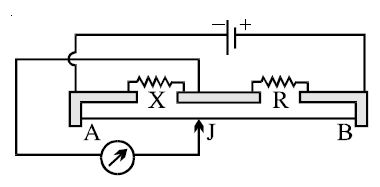
- 3The figure shows a meter-bridge circuit, with $AB = 100\, cm$,$ X = 12\,\Omega$ and $R = 18\,\Omega$ , and the jockey $J$ in the position of balance. If $R$ is now made $8\,\Omega$ , through what distance will $J$ have to be moved to obtain balance? .............. $cm$View Solution
- 4Two wires that are made up of two different materials whose specific resistance are in the ratio $2 : 3$, length $3 : 4$ and area $4 : 5$. The ratio of their resistances isView Solution
- 5A cell of $emf$ $E$ and internal resistance $r$ is connected in series with an external resistacne $nr.$ Then, the ratio of the terminal potential difference to $emf$ isView Solution
- 6When the current $i$ is flowing through a conductor, the drift velocity is $v$. If $2i$ current is flowed through the same metal but having double the area of cross-section, then the drift velocity will beView Solution
- 7A set of $n$ equal resistors, of value $R$ each, are connected in series to a battery of emf $E$ and internal resistance $R.$ The current drawn is $I.$ Now, the $n$ resistors are connected in parallel to the same battery. Then the current drawn from battery becomes $10\,I.$ The value of $n$ isView Solution
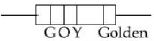
- 8View SolutionA carbon resistance has a following colour code. What is the value of the resistance?
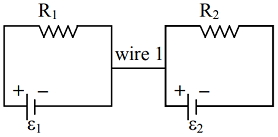
- 9In the circuit, wire $1$ is of negligible resistance. Then,View Solution
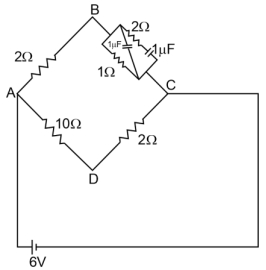
- 10For the given circuit, in the steady state, $\left| V _{ B }- V _{ D }\right|=.......V.$View Solution