Question
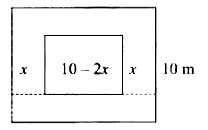
There is a square field whose side is 10 m. A square flower bed is prepared in its centre leaving a gravel path all round the flower bed. The total cost of laying the flower bed and gravelling the path at ₹ 3 and ₹ 4 per square metre respectively is ₹ 364. Find the width of the gravel path
Answer

Let the width of the gravel path be ‘x’
Side of the flower bed = 10 – (x + x)
= 10 – 2x

Area of the path way $=$ Area of the field - Area of the flower bed
$=10 \times 10-(10-2 x)(10-2 x) \text { sq.m }$
$=100-\left(100+4 x^2-40 x\right)$
$=100-100-4 x^2+40 x$
$=40 x-4 x^2 \text { sq.m }$
Area of the flower bed $=(10-2 x)(10-2 x)$ sq.m.
$=100+4 x^2-40 x$
By the given condition

$3\left(100+4 x^2-40 x\right)+4\left(40 x-4 x^2\right)=364 \\
$300+12 x^2-120 x+160 x-16 x^2=364$
$-4 x^2+40 x+300-364=0$
$-4 x^2+40 x-64=0$
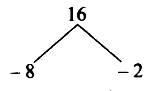
$\Rightarrow x^2-10 x+16=0 \ldots(\div \text { by } 4)$
[The width must not be equal to 8 m since the side of the field is 10 m ]
$(x-8)(x-2)=0 $
$x-8=0 \text { or } x-2=0 $
$x=8 \text { or } x=2$
Width of the gravel path $=2 m$

Need a full question paper?

Generate a complete, print-ready paper with questions like this in minutes — across 16+ boards, with answer keys.

Start Generating Free

Similar questions

Construct a triangle similar to a given triangle $A B C$ with its sides equal to $\frac{6}{5}$ of the corresponding sides of the triangle $ABC$ (scale factor $\frac{6}{5}>1$ )
Without using distance formula, show that the points (−2, −1), (4, 0), (3, 3) and (−3, 2) are vertices of a parallelogram
Find the middle term(s) of an A.P. $9, 15, 21, 27, …, 183.$
From a solid cylinder whose height is 2.4 cm and the diameter 1.4 cm, a cone of the same height and same diameter is carved out. Find the volume of the remaining solid to the nearest cm$^3$.
$D E \| B C$ and $C D \| E E$ Prove that $A D^2=A B \times A F$
Find the non-zero values of $x$ satisfying the matrix equation
$
x\left[\begin{array}{cc}
2 x & 2 \\
3 & x
\end{array}\right]+2\left[\begin{array}{cc}
8 & 5 x \\
4 & 4 x
\end{array}\right]=2\left[\begin{array}{cc}
x^2+8 & 24 \\
10 & 6 x
\end{array}\right]
$
A hemispherical bowl is filled to the brim with juice. The juice is poured into a cylindrical vessel whose radius is 50% more than its height. If the diameter is same for both the bowl and the cylinder then find the percentage of juice that can be transferred from the bowl into the cylindrical vessel.
At $t$ minutes past $2 pm$, the time needed to $3 pm$ is 3 minutes less than $\frac{ t ^2}{4}$. Find $t$.
If $A=\left[\begin{array}{lll}5 & 2 & 9 \\ 1 & 2 & 8\end{array}\right], B=\left[\begin{array}{cc}1 & 7 \\ 1 & 2 \\ 5 & -1\end{array}\right]$ verify that $(A B)^{\top}=B^{\top} A^{\top}$
The data in the adjacent table depicts the length of a person's forehand and their corresponding height. Based on this data, a student finds a relationship between the height (y) and the forehand length (x) as y = ax + b, where a, b are constant.
Length ‘x’ of
forehand (in cm)
Height 'y'
(in inches)
35 56
45 65
50 69.5
55 74
Find the length of forehand of a person if the height is 53.3 inches