Question
There is a sudden increase in current in zener diode is:

Answer

  1. Due to rupture of bonds
Explanation:
When Zener diode is connected in reverse bias, as applied voltage reaches at Zener breakdown voltage, due to rupture of bonds there is a sudden increase in current in Zener diode.

Need a full question paper?

Generate a complete, print-ready paper with questions like this in minutes — across 16+ boards, with answer keys.
Start Generating Free

Similar questions

A beam of parallel rays is brought to a focus by a plano-convex lens. A thin concave lens of the same focal length is joined to the first lens. The effect of this is(a) The focal point shifts away from the lens by a small distance(b) The focus remains undisturbed(c) The focus shifts to infinity (d) The focal point shifts towards the lens by a small distance


Who discovered the magnetic effect of electric current?
The separation between the plates of a charged parallel-plate capacitor is increased. Which of the following quantities will change?
Is the ratio of frequencies of UV rays and IR rays in the glass more than, less than or equal to 1?
Chromatic aberration of lens can be corrected by(a) Reducing its aperature  (b) Proper polishing of its two surfaces(c) Suitably combining it with another lens(d) Providing different suitable curvature to its two surfaces


Root mean square value of ac voltage $V=$ $200 \sin \left(100 \pi t+\frac{\pi}{2}\right)$ is :
The half life of $131_I$ is $8$ days. Given a sample of $131_I$ at time $t = 0,$ we can assert that
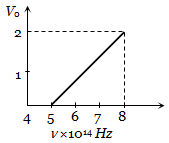
The stopping potential $(V_0)$ versus frequency $(n)$ plot of a substance is shown in figure the threshold wave length is
A paramagnetic sample shows a net magnetisation of $8Am^{-1}$ when placed in an external magnetic field of $0.6T$ at a temperature of $4K.$ When the same sample is placed in an external magnetic field of $0.2T$ at a temperature of $16K,$ the magnetisation will be
Which type of current is flowing through a circuit?