Question
There will be no force between two wires carrying currents if currents are:

Answer

  1. Perpendicular to each other
Explanation:
Force on a current carrying wire placed in a magnetic field is given by F = I (l × B) So when the wires are perpendicular the magnetic field produced by one of them will be along the length of the other and we know cross product of two vectors along the same direction is zero.

Need a full question paper?

Generate a complete, print-ready paper with questions like this in minutes — across 16+ boards, with answer keys.
Start Generating Free

Similar questions

A parallel plate air capacitor has capacity ′C′ farad, potential ′V′ volt and energy ′E′ joule. When the gap between the plates is completely filled with dielectric.
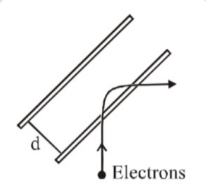
A problem of practical interest is to make a beam of electrons turn at $90^\circ$ corner. This can be done with the parallel plates shown in figure. An electron with kinetic energy $8.0 \times 10^{-17}J$ enters through a small hole in the bottom plate. The strength of electric field that is needed if the electron is to emerge from an exit hole $1.0\ cm$ away from the entrance hole, traveling at right angles to its original direction is $........... \times10^5N/ C.$
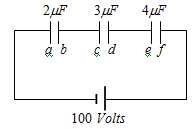
Three capacitors are connected to $D.C.$  source of $100$ volts  shown in the adjoining figure. If the charge accumulated on plates of $C_1,C_2$ and $C_3$  are $q_{a}, q_{b}, q_{c}, q_{d}, q_{e}$ and  $q_{f}$  respectively, then
If the central portion of a convex lens is wrapped in black paper as shown in the figure
The dimensions of electric potential are:
A strip of copper and another of germanium are cooled from room temperature to 80K. The resistance of:
Equipotential surface is:
Pick out the correct statement from the following about parallel combination of resistors.
The S.I. unit of electric flux is:
Two like magnetic poles of strength 10 and 40 SI units are separated by a distance 30 cm. The intensity of magnetic field is zero on the line joining them(a) At a point 10 cm from the stronger pole(b) At a point 20 cm from the stronger pole(c) At the mid-point(d) At infinity