MCQ
Thermions are
  • A
    protons
  • B
    photons
  • electrons
  • D
    positrons

Answer

Correct option: C.
electrons
c
An electrically charged particle or ion that is emitted by a heated conducting material. The electrons emitted from the cathodes of electron tubes (such as cathode ray tubes) are known as thermions.

Need a full question paper?

Generate a complete, print-ready paper with questions like this in minutes — across 16+ boards, with answer keys.
Start Generating Free

Similar questions

Water rises in a vertical capillary tube upto a length of 10cm. If the tube is inclined at 45°, the length of water risen in the tube will be:
The photoelectric effect can be understood on the basis of
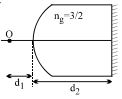
In the figure shown a point object $O$ is placed in air on the principal axis. The radius of curvature of the spherical surface is $60\, cm$. If is the final image formed after all the refractions and reflections.
The focal lengths of the objective and eye lenses of a telescope are respectively $200 \,cm$ and $5 \,cm.$ The maximum magnifying power of the telescope will be
In case of a semiconductor, which of the following statement is wrong
Two sources of light of wavelengths $2500{\text{ }}\mathop {\text{A}}\limits^o $ and $3500{\text{ }}\mathop {\text{A}}\limits^o $ are used in Young’s double slit expt. simultaneously. Which orders of fringes of two wavelength patterns coincide ?
An electron is projected with velocity $v_0$ in a uniform electric field $E$ perpendicular to the field. Again it is projetced with velocity $v_0$ perpendicular to a uniform magnetic field $B/$ If $r_1$ is initial radius of curvature just after entering in the electric field and $r_2$ is initial radius of curvature just after entering in magnetic field then the ratio $r_1:r_2$ is equal to 
prism can produce a minimum deviation $\delta$ in a light beam. If three such prisms are combined, the minimum deviation that can be produced in this beam is:
At room temperature, copper has free electron density of $ 8.4 \times 10^{28}$ per $m^3$. The copper conductor has a cross-section of $10^{-6}$ m$^2$ and carries a current of 5.4 A. The electron drift velocity in copper is
A battery of $6\, volts$ is connected to the terminals of a three meter long wire of uniform thickness and resistance of the order of $100\,\Omega $. The difference of potential between two points separated by $50\,cm$ on the wire will be .......... $V$