MCQ
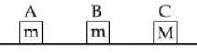
Three blocks $A, B$ and $C$ are lying on a smooth horizontal surface, as shown in the figure. $A$ and $B$ have equal masses, $m$ while $C$ has mass $M$. Block $A$ is given an initial speed $v$ towards $B$ due to which it collides with $B$ perfectly inelastically. The combined mass collides with $C$, also perfectly inelastically. The combined mass collides with $C$, also perfectly inelastically if $\frac{5}{6}^{th}$ of the initial kinetic energy is lost in whole process. What is value of $M/m$ ?
  • A
    $5$
  • B
    $2$
  • $4$
  • D
    $3$

Answer

Correct option: C.
$4$
c
Apply $LMC$ (Linear Momentum Conservation)

$mv = (2m + M) v'$

$v' = \frac{{mv}}{{2m + M}}$

Initial energy 

$\frac{1}{2}$ $m{v^2}$

Final energy 

$\frac{1}{2}\,\left( {2m + M} \right){\left( {\frac{{mv}}{{2m + M}}} \right)^2}$

$Initial\, kinetic\, energy - Final\, Kinetic\, energy =$  $\frac{5}{6}$ of initial kinetic energy.

After solving, we get, $\frac{M}{m} = 4.$

Need a full question paper?

Generate a complete, print-ready paper with questions like this in minutes — across 16+ boards, with answer keys.

Start Generating Free

Similar questions

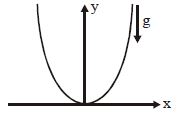
A particle of mass $5 × 10^{-5}\  kg$ is placed at lowest point of smooth parabola  $x^2$ = $40y$  ($x$ and $y$ in $m$) (in $rad/s$). If it is displaced slightly such that it is constrained to move along parabola, angular frequency of oscillation will be approximately
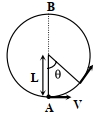
A bob of mass $\mathrm{M}$ is suspended by a massless string of length $\mathrm{L}$. The horizontal velocity $\mathrm{V}$ at position $\mathrm{A}$ is just sufficient to make it reach the point $B$. The angle $\theta$ at which the speed of the bob is half of that at $A$, satisfies Figure:
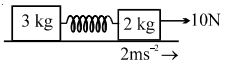
Find the acceleration of $3 kg$ mass when acceleration of $2 kg$ mass is $2 ms^{^{-2}}$ as shown in figure. ......... $ms^{-2}$
Which of the following quantities increase when wavelength is increased? Consider only the magnitudes.
  1. The power of a converging lens.
  2. The focal length of a converging lens.
  3. The power of a diverging lens.
  4. The focal length of a diverging lens.
A wheel is of diameter $1\ m.$ If it makes $30$ revolution per second, then the linear speed of a point on its circumference will be 
If $L = 2.331\,cm,\;B = 2.1\,cm$, then $L + B = $
A body is projected at an angle $\theta $ with horizontal, another body is projected with the same speed at an angle $\theta $ with the vertical then the ratio of the maximum height is
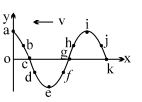
The figure represents the instantaneous picture of a longitudinal harmonic wave travelling along the negative $x$-axis. Identify the correct statement $(s)$ related to the movement of the points shown in the figure. The stationary points are
Young's modulus of steel is $1.9 \times 10^{11} \mathrm{~N} / \mathrm{m}^2$. When expressed in CGS units of dynes $/ \mathrm{cm}^2$, it will be equal to $(1 \mathrm{~N}=$ $10^5$ dyne, $1 \mathrm{~m}^2=10^4 \mathrm{~cm}^2)$.
 
Which of the following affects the elasticity of a substance