Question
Three blocks are connected as shown on a horizontal frictionless table, and pulled to the right with a force of $T_3 = 60N$.

If $m_1 = 10kg, m_2 = 20kg$ and $m_3 = 30kg$. Prove that $\frac{\text{T}_1}{\text{T}_2}=\frac{1}{3}.$

Answer

From the forces acting along the horizontal (shown below) $T_1=m_1 a \ldots$...(i) $T_2-T_1=m_2 a \ldots$
(ii) $T_3-T_2=m_3 a \ldots$ Adding equation (i), (ii) and (iii), we get $T_3=\left(m_1+m_2+m_3\right)$ a or $a=\frac{T_3}{m_1+m_2+m_3}$

Putting various values, we get $\text{a}=\frac{60}{10+20+30}=\frac{60}{60}=1\text{ ms}^{-2}$
$\therefore T_1 = m_1a = 10N$ and $T_2 - T_1 = m_2a = (20 \times 1)N$ or $T_2 = (10 + 20)N = 30N$ Thus the required ratio $\frac{\text{T}_1}{\text{T}_2}=\frac{10}{30}=\frac{1}{3}$

Need a full question paper?

Generate a complete, print-ready paper with questions like this in minutes — across 16+ boards, with answer keys.

Start Generating Free

Similar questions

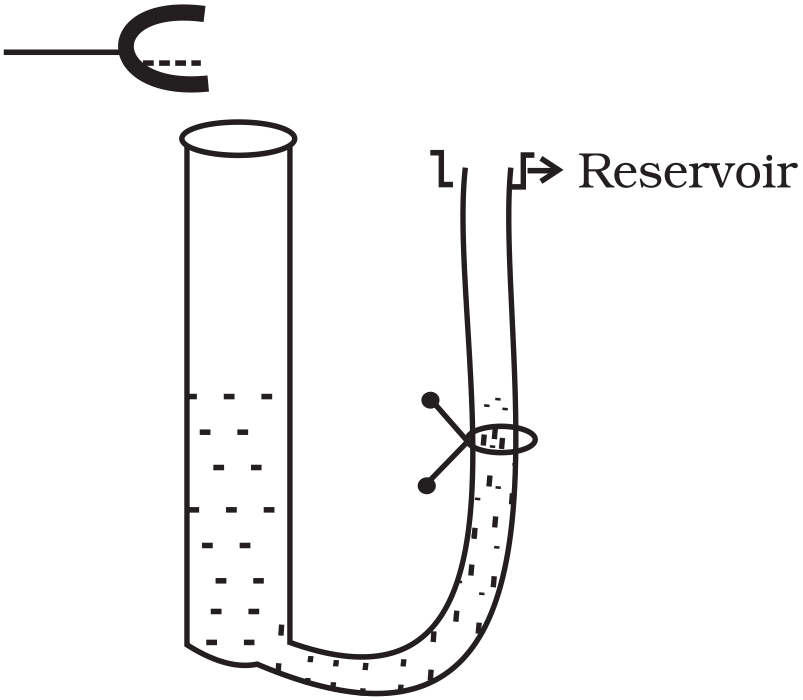
A tuning fork vibrating with a frequency of 512Hz is kept close to the open end of a tube filled with water The water level in the tube is gradually lowered. When the water level is 17cm below the open end, maximum intensity of sound is heard. If the room temperature is 20° C, calculate
  1. Speed of sound in air at room temperature
  2. Speed of sound in air at 0° C
  3. If the water in the tube is replaced with mercury, will there be any difference in your observations?
A rocket is fired ‘vertically’ from the surface of mars with a speed of $2km\ s^{-1}$. If $20\%$ of its initial energy is lost due to martian atmospheric resistance, how far will the rocket go from the surface of mars before returning to it? Mass of mars $= 6.4 \times 10^{23}kg;$ radius of mars $= 3395km;\ G = 6.67 \times 10^{-11}N\ m^2\ kg^{-2}.$
Define gravitational potential energy of a body. Derive an expression for the gravitational potential energy of a body of mass 'm' located at a distance 'r' from the centre of the earth.
A geyser heats water flowing at the rate of $3.0$ litres per minute from $27°C$ to $77°C$. If the geyser operates on a gas burner, what is the rate of consumption of the fuel if its heat of combustion is $4.0 × 10⁴J/g$?
The conductivity of an intrinsic samiconductor depends on temperature as $\sigma=\sigma_0\text{ e}^{\frac{-\Delta\text{E}}{2\text{kT}}}$ where $\sigma_0$ is a constant. Find the temperature at which the conductivity pf an intrinsic germanium semiconductor will be double of its value at T = 300K. Assume that the gap for germanium is 0.650eV and remains constant as the temperature is increased.
A wire of length I and area of cross-section A is stretched by the application of a force. If the Young's modulus is Y, what is the work done per unit volume?
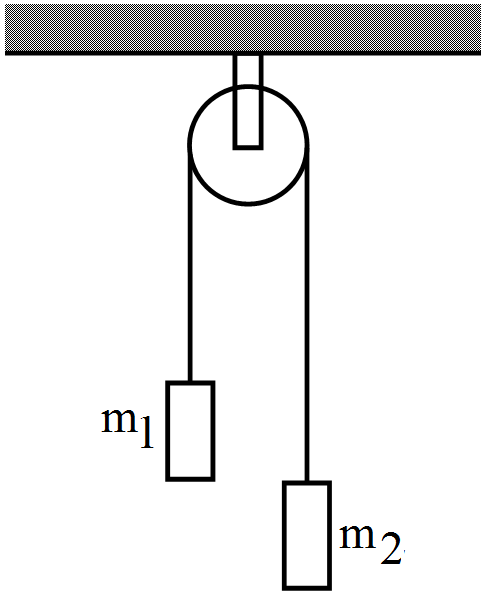
In a simple Atwood machine, two unequal masses $m_1$ and $m_2$ are connected by a string going over a clamped light smooth pulley. In a typical arrangement $m_1 = 300g$ and $m_2 = 600g$. The system is released from rest.
  1. Find the distance travelled by the first block in the first two seconds.
  2. Find the tension in the string.
  3. Find the force exerted by the clamp on the pulley.
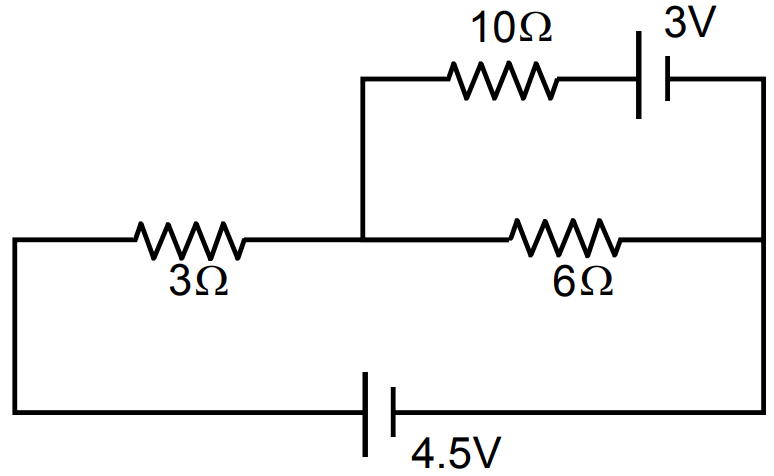
Find the current through the $10\Omega$ resistor shown in figure.
A uniform rod of mass m and length l is struck at an end by a force F perpendicular to the rod for a short time interval t. Calculate:
  1. The speed of the centre of mass.
  2. The angular speed of the rod about the centre of mass.
  3. The kinetic energy of the rod.
  4. The angular momentum of the rod about the centre of mass after the force has stopped to act. Assume that t is so small that the rod does not appreciably change its direction while the force acts.
What is Bernoulli's theory for horizontal tube?