Three capacitances of capacity$10\,\mu F,\;5\,\mu F$ and $5\,\mu F$ are connected in parallel. The total capacity will be........$\mu F$
Easy


Download our appand get started for free
Experience the future of education. Simply download our apps or reach out to us for more information. Let's shape the future of learning together!No signup needed.*
Similar Questions
- 1View SolutionThe potential to which a conductor is raised, depends on
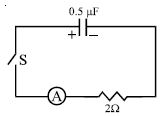
- 2A charged capacitor is allowed to discharge through a resistance $2\,\Omega $ by closing the switch $S $ at the instant $t = 0$. At time $t = ln$ $2$ $\mu s$, the reading of the ammeter falls half of its initial value. The resistance of the ammeter equal toView Solution
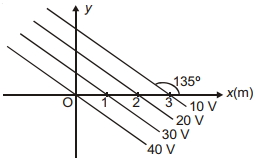
- 3View SolutionFigure shows a set of equipotential surfaces. The magnitude and direction of electric field that exists in the region is .........
- 4Two positive point charges of $12\,\mu C$ and $8\,\mu C$ are $10\,cm$ apart. The work done in bringing them $4\, cm$ closer isView Solution
- 5Two capacitors of capacities $2 {C}$ and ${C}$ are joined in parallel and charged up to potential ${V}$. The battery is removed and the capacitor of capacity $C$ is filled completely with a medium of dielectric constant ${K}$. The potential difference across the capacitors will now beView Solution
- 6Ten charges are placed on the circumference of a circle of radius $R$ with constant angular separation between successive charges. Alternate charges $1,3,5,7,9$ have charge $(+q)$ each, while $2,4,6,8,10$ have charge $(-q)$ each. The potential $V$ and the electric field $E$ at the centre of the circle are respectivelyView Solution
(Take $V =0$ at infinity $)$
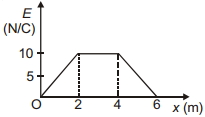
- 7Figure shows the variation of electric field intensity $E$ versus distance $x$. What is the potential difference between the points at $x=2 \,m$ and at $x=6 \,m$ from $O$ is ............. $V$View Solution
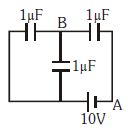
- 8If potential of $A$ is $10\,V$, then potential of $B$ isView Solution
- 9The capacitor of capacitance $4\,\mu F$ and $6\,\mu F$ are connected in series. A potential difference of $500\;volts$ applied to the outer plates of the two capacitor system. Then the charge on each capacitor is numericallyView Solution
- 10If an electron enters into a space between the plates of a parallel plate capacitor at an angle $\alpha $ with the plates and leaves at an angle $\beta $ to the plates, the ratio of its kinetic energy while entering the capacitor to that while leaving will beView Solution