Two positive point charges of $12\,\mu C$ and $8\,\mu C$ are $10\,cm$ apart. The work done in bringing them $4\, cm$ closer is
Medium
Download our app for free and get started
(c) $W = {U_f} - {U_i} = 9 \times {10^9} \times {Q_1}\,{Q_2}\left[ {\frac{1}{{{r_2}}} - \frac{1}{{{r_1}}}} \right]$
$==>$ $W = 9 \times {10^9} \times 12 \times {10^{ - 6}} \times 8 \times {10^{ - 6}}\left[ {\frac{1}{{4 \times 10{\,^{ - 2}}}} - \frac{1}{{10\, \times 10{\,^{ - 2}}}}} \right]$ $= 12.96 \,J ≈ 13 \,J$
$==>$ $W = 9 \times {10^9} \times 12 \times {10^{ - 6}} \times 8 \times {10^{ - 6}}\left[ {\frac{1}{{4 \times 10{\,^{ - 2}}}} - \frac{1}{{10\, \times 10{\,^{ - 2}}}}} \right]$ $= 12.96 \,J ≈ 13 \,J$

Download our appand get started for free
Experience the future of education. Simply download our apps or reach out to us for more information. Let's shape the future of learning together!No signup needed.*
Similar Questions
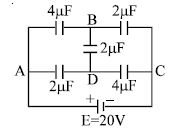
- 1The figure shows a diagonal symmetric arrangement of capacitors and a battery. The potential of the point $B$ and $D$ areView Solution
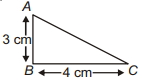
- 2$A B C$ is a right angled triangle situated in a uniform electric field $\vec{E}$ which is in the plane of the triangle. The points $A$ and $B$ are at the same potential of $15 \,V$ while the point $C$ is at a potential of $20 \,V . A B=3 \,cm$ and $B C=4 \,cm$. The magnitude of electric field is (in $S.I.$ Units)View Solution
- 3A dipole consisting of two charge $\pm q$ separated by a distance $2 a$ is placed with its centre $D$ away from the center of a grounded sphere of radius $R ( D > > a )$. When the dipole moment vector is perpendicular to the line joining the two centres (those of the dipole and sphere) the charge induced on the sphere isView Solution
- 4A conducting sphere of radius $R$ is given a charge $Q.$ The electric potential and the electric field at the centre of the sphere respectively areView Solution
- 5A parallel plate capacitor Air filled with a dielectric whose dielectric constant varies with applied voltage as $K = V$. An identical capacitor $B$ of capacitance $C_0$ with air as dielectric is connected to voltage source $V_0 = 30\,V$ and then connected to the first capacitor after disconnecting the voltage source. The charge and voltage on capacitor.View Solution
- 6The plates of a parallel plate capacitor with no dielectric are connected to a voltage source. Now a dielectric of dielectric constant $K $ is inserted to fill the whole space between the plates with voltage source remaining connected to the capacitor.View Solution
- 7Two point charges $100\,\mu \,C$ and $5\,\mu \,C$ are placed at points $A$ and $B$ respectively with $AB = 40\,cm$. The work done by external force in displacing the charge $5\,\mu \,C$ from $B$ to $C$, where $BC = 30\,cm$, angle $ABC = \frac{\pi }{2}$ and $\frac{1}{{4\pi {\varepsilon _0}}} = 9 \times {10^9}\,N{m^2}/{C^2}$.........$J$View Solution
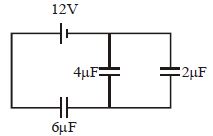
- 8The charge deposited on $4\,\mu F$ capacitor in the circuit isView Solution
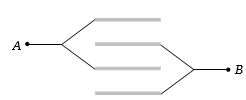
- 9Four plates of the same area of cross-section are joined as shown in the figure. The distance between each plate is $d$. The equivalent capacity across $A$ and $B$ will beView Solution
- 10Ten charges are placed on the circumference of a circle of radius $R$ with constant angular separation between successive charges. Alternate charges $1,3,5,7,9$ have charge $(+q)$ each, while $2,4,6,8,10$ have charge $(-q)$ each. The potential $V$ and the electric field $E$ at the centre of the circle are respectivelyView Solution
(Take $V =0$ at infinity $)$