The capacitor of capacitance $4\,\mu F$ and $6\,\mu F$ are connected in series. A potential difference of $500\;volts$ applied to the outer plates of the two capacitor system. Then the charge on each capacitor is numerically
Medium
Download our app for free and get started
(c) ${C_{eq}} = \frac{{{C_1}{C_2}}}{{{C_1} + {C_2}}} = 2.4\,\mu F.$
Charge flown $= 2.4 \times 500 \times 10^{-6} C =1200 \,\mu C.$
Charge flown $= 2.4 \times 500 \times 10^{-6} C =1200 \,\mu C.$

Download our appand get started for free
Experience the future of education. Simply download our apps or reach out to us for more information. Let's shape the future of learning together!No signup needed.*
Similar Questions
- 1Dipole having dipole moment $4\,C-m$ is placed on origin along $x-$ axis. Point charge of $8\,\mu C$ is fixed at $(4, 0, 0)$ . Now dipole is rotated by an angle of $\frac{\pi }{2}$ . Find the work done (in $mJ$ ) in rotating the dipole.......$mJ$View Solution
- 2How will the voltage $(V)$ between the two plates of a parallel plate capacitor depend on the distance $(d)$ between the plates, if the charge on the capacitor remains the same?View Solution
- 3The plates of a parallel plate capacitor are charged up to $100\, volt$. A $2\, mm$ thick plate is inserted between the plates, then to maintain the same potential difference, the distance between the capacitor plates is increased by $1.6\, mm$. The dielectric constant of the plate isView Solution
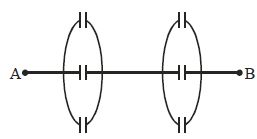
- 4All the six capacitors shown in the circuit are identical. Each can withstand maximum $200\, volt$ between its terminals. The maximum voltage that can be applied safely between $A$ and $B$ is.....$V$View Solution
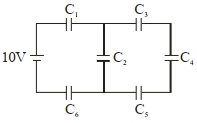
- 5In the given circuit, $C _1=2\,\mu F , C _2=0.2\,\mu F$, $C _3=2\,\mu F , C _4=4\,\mu F,$ $C _5=2\,\mu F , C _6=2\,\mu F$, the charge stored on capacitor $C _4$ is $.....\mu C$.View Solution
- 6The capacity of a condenser is $4 \times {10^{ - 6}}$ farad and its potential is $100\,\,volts$. The energy released on discharging it fully will be.......$Joule$View Solution
- 7Four metal conductors having different shapesView Solution
$1.$ A sphere $2.$ Cylindrical
$3.$ Pear $4.$ Lightning conductor
are mounted on insulating stands and charged. The one which is best suited to retain the charges for a longer time is
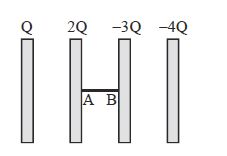
- 8View SolutionFour very large metal plates are given the charges as shown in figure. The middle two are then connected through a wire. Find the charge that will flow through the wire
- 9What is the potential difference between $A$ and $B$ in the circuit shown.......$V$View Solution
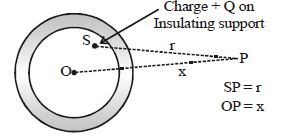
- 10The adjacent diagram shows a charge $+Q$ held on an insulating support $S$ and enclosed by a hollow spherical conductor. $O$ represents the centre of the spherical conductor. and $P$ is a point such that $OP = x $ and $SP = r$ . The electric field at point $P$ will beView Solution