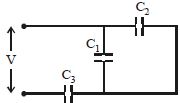
Three capacitors $C_1,\,C_2$ and $C_3$ are connected as shown in the figure to a battery of $V\,volt$. If the capacitor $C_3$ breaks down electrically the change in total charge on the combination of capacitors is
AIIMS 2010, Diffcult
Download our app for free and get started
Equivalent capacitance of circuit,
$\frac{1}{C_{e q}}=\frac{1}{C_{3}}+\frac{1}{C_{1}+C_{2}}$
(since $\mathrm{C}_{1}$ and $\mathrm{C}_{2}$ are in parallel and which is in series with ${\mathrm{C}}_{3}$ ).
ie, $\frac{1}{\mathrm{C}_{\mathrm{eq}}}=\frac{\mathrm{C}_{1}+\mathrm{C}_{2}+\mathrm{C}_{3}}{\mathrm{C}_{3}\left(\mathrm{C}_{1}+\mathrm{C}_{2}\right)}$
$\therefore C_{e q}=\frac{C_{3}\left(C_{1}+C_{2}\right)}{C_{1}+C_{2}+C_{3}}$
since $V$ is the voltage of battery, charge, $\mathrm{q}=\mathrm{C}_{\mathrm{eq}} \mathrm{V}$
$=\frac{\mathrm{C}_{3}\left(\mathrm{C}_{1}+\mathrm{C}_{2}\right) \mathrm{V}}{\mathrm{C}_{1}+\mathrm{C}_{2}+\mathrm{C}_{3}}$
If the capacitor $\mathrm{C}_{3}$ breaks down, then effective capacitance, $C_{e q}^{\prime}=C_{1}+C_{2}$
New charge $q'=$ $\mathrm{C}_{\mathrm{eq}}^{\prime} \mathrm{V}=\left(\mathrm{C}_{1}+\mathrm{C}_{2}\right) \mathrm{V}$
Change in total charge $=q^{\prime}-q$
$=\left(\mathrm{C}_{1}+\mathrm{C}_{2}\right) \mathrm{V}-\frac{\mathrm{C}_{3}\left(\mathrm{C}_{1}+\mathrm{C}_{2}\right) \mathrm{V}}{\mathrm{C}_{1}+\mathrm{C}_{2}+\mathrm{C}_{3}}$
$=\left(\mathrm{C}_{1}+\mathrm{C}_{2}\right) \mathrm{V}\left[1-\frac{\mathrm{C}_{3}}{\mathrm{C}_{1}+\mathrm{C}_{2}+\mathrm{C}_{3}}\right]$

Download our appand get started for free
Experience the future of education. Simply download our apps or reach out to us for more information. Let's shape the future of learning together!No signup needed.*
Similar Questions
- 1Assertion : A parallel plate capacitor is connected across battery through a key. A dielectric slab of dielectric constant $K$ is introduced between the plates. The energy which is stored becomes $K$ times.View Solution
Reason : The surface density of charge onthe plate remains constant or unchanged.
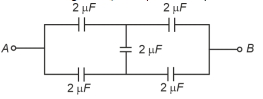
- 2In the following circuit, the equivalent capacitance between terminal $A$and terminal $B$ is :View Solution
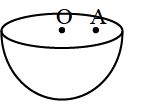
- 3Charge is uniformly distributed on the surface of a hollow hemisphere. Let $O$ and $A$ be two points on the base of the hemisphere and $V_0$ and $V_A$ be the electric potentials at $O$ and $A$ respectively. Then,View Solution
- 4If on the $x$-axis electric potential decreases uniformly from $60 \,V$ to $20 \,V$ between $x=-2 \,m$ to $x=+2 \,m$, then the magnitude of electric field at the originView Solution
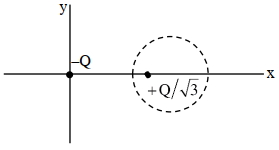
- 5Two point charges $-Q$ and $+Q / \sqrt{3}$ are placed in the xy-plane at the origin $(0,0)$ and a point $(2,0)$, respectively, as shown in the figure. This results in an equipotential circle of radius $R$ and potential $V =0$ in the $xy$-plane with its center at $(b, 0)$. All lengths are measured in meters.View Solution
($1$) The value of $R$ is. . . . meter.
($2$) The value of $b$ is. . . . . .meter.
- 6A series combination of $n_1$ capacitors, each of value $C_1$ is charged by a source of potential difference $4\, V.$ When another parallel combination of $n_2$ capacitors, each of value $C_2,$ is charged by a source of potential difference $V$, it has the same (total) energy stored in it, as the first combination has. The value of $C_2,$ in terms of $C_1$ is thenView Solution
- 7An electric field of $1000\,V/m$ is applied to an electric dipole at angle of $45^o$. The value of electric dipole moment is $10^{-29}\, C.m.$ What is the potential energy of the electric dipole?View Solution
- 8A conducting sphere of radius $r$ has a charge. ThenView Solution
- 9The distance between the plates of a parallel plate condenser is $\,4mm$ and potential difference is $60\;volts$. If the distance between the plates is increased to $12\,mm$, thenView Solution
- 10A point dipole $\vec p = - {p_0}\hat x$ is kept at the origin. The potential and electric field due to this dipole on the $y-$ axis at a distance $d$ are, respectively : (Take $V = 0$ at infinity)View Solution