Three capacitors each of capacitance $C$ and of breakdown voltage $V$ are joined in series. The capacitance and breakdown voltage of the combination will be
AIPMT 2009, Easy


Download our appand get started for free
Experience the future of education. Simply download our apps or reach out to us for more information. Let's shape the future of learning together!No signup needed.*
Similar Questions
- 1A parallel plate capacitor has plates of area $A$ separated by distance $d$ between them. It is filled with a dielectric which has a dielectric constant that varies as $\mathrm{k}(\mathrm{x})=\mathrm{K}(1+\alpha \mathrm{x})$ where $\mathrm{x}$ is the distance measured from one of the plates. If $(\alpha \text {d)}<<1,$ the total capacitance of the system is best given by the expressionView Solution
- 2A $4\, \,\mu F$ condenser is charged to $400\, V$ and then its plates are joined through a resistance. The heat produced in the resistance is.......$J$View Solution
- 3A force of $10 \; N$ acts on a charged particle placed between two plates of a charged capacitor. If one plate of capacitor is removed, then the force acting on that particle will be ...... $N$View Solution
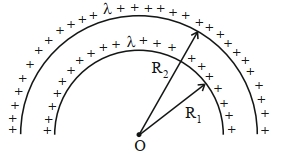
- 4The electric potential at the centre of two concentric half rings of radii $R_1$ and $R_2$, having same linear charge density $\lambda$ isView Solution
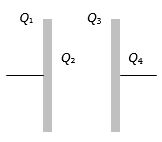
- 5In an isolated parallel plate capacitor of capacitance $C$, the four surface have charges ${Q_1}$, ${Q_2}$, ${Q_3}$ and ${Q_4}$ as shown. The potential difference between the plates isView Solution
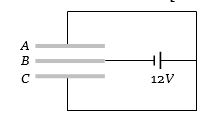
- 6Three plates $A,\;B,\;C$each of area $50\,c{m^2}$ have separation $3\,mm$ between $A$ and $B$ and $3\,mm$ between $B$ and $C$. The energy stored when the plates are fully charged isView Solution
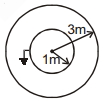
- 7Figure shows a solid conducting sphere of radius $1 m$, enclosed by a metallic shell of radius $3 \,m$ such that their centres coincide. If outer shell is given a charge of $6 \,\mu C$ and inner sphere is earthed, find magnitude charge on the surface of inner shell is ............. $\mu C$View Solution
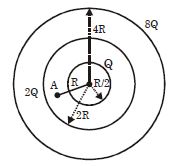
- 8Three charged concentric nonconducting shells are given as shown in figure. Find the potential at point $A$View Solution
- 9Three point charges $q, q$ and $-2 q$ are placed at the corners of an equilateral triangle of side '$L$'. Calculate work done by extemal force in moving all the charges far apart without accelerationView Solution
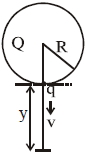
- 10A solid sphere of radius $R$ carries a charge $(Q+q)$ distributed uniformly over its volume. A very small point like piece of it of mass $m$ gets detached from the bottom of the sphere and falls down vertically under gravity. This piece carries charge $q.$ If it acquires a speed $v$ when it has fallen through a vertical height $y$ (see figure), then :View Solution
(assume the remaining portion to be spherical).