Question
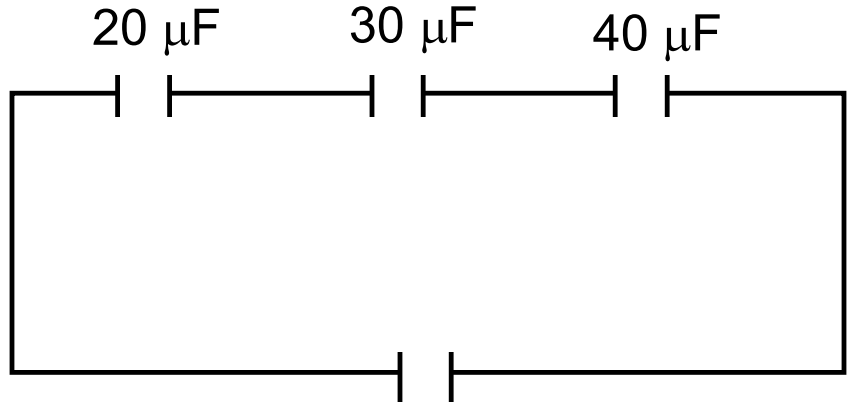
Three capacitors having capacitances $20\mu\text{F},\ 30\mu\text{F}$ and $40\mu\text{F}$ are connected in series with a 12V battery. Find the charge on each of the capacitors. How much work has been done by the battery in charging the capacitors?
Answer


$\therefore$ The equivalent capacity
$\text{C}=\frac{\text{C}_1\text{C}_2\text{C}_3}{\text{C}_2\text{C}_3+\text{C}_1\text{C}_3+\text{C}_1\text{C}_2}$
$=\frac{20\times30\times40}{30\times40+20\times40+20\times30}=\frac{24000}{2600}=9.23\mu\text{F}$
Let Equivalent charge at the capacitor = q
$\text{C}=\frac{\text{q}}{\text{V}}$
$\Rightarrow\text{q}=\text{C}\times\text{V}=9.23\times12=110\mu\text{C}$ on each.
As this is a series combination, the charge on each capacitor is same as the equivalent charge which is $110\mu\text{C}.$
Let the work done by the battery = W
$\therefore\text{V}=\frac{\text{W}}{\text{q}}$
$\Rightarrow\text{W}=\text{Vq}=110\times12\times10^{-6}$
$=1.33\times10^{-3}\text{J.}$

Need a full question paper?

Generate a complete, print-ready paper with questions like this in minutes — across 16+ boards, with answer keys.

Start Generating Free

Similar questions

A capacitor having a capacitance of $100\mu\text{F}$ is charged to a potential difference of 50V.
  1. What is the magnitude of the charge on each plate?
  2. The charging battery is disconnected and a dielectric of dielectric constant 2.5 is inserted. Calculate the new potential difference between the plates.
  3. What charge would have produced this potential difference in absence of the dielectric slab.
  4. Find the charge induced at a surface of the dielectric slab.
0.040g of He is kept in a closed container initially at 100.0°C. The container is now heated. Neglecting the expansion of the container, calculate the temperature at which the internal energy is increased by 12J.
In Fig. the energy stored in $C _4$ is $27 J$ . Calculate the total energy stored in the system.
Image
Take $\text{C}_1=4.0\mu\text{F}$ and $\text{C}_2=6.0\mu\text{F}$ in figure. Calculate the equivalent capacitance of the combination between the points indicated.

A $20\mu\text{F}$ capacitor is joined to a battery of emf 6.0V through a resistance of $100\Omega.$ Find the charge on the capacitor 2.0ms after the connections are made.
The property of diamagnetism is said to be present in all materials. Then, why are some materials paramagnetic or ferromagnetic?
A current of 1.0A exists in a copper wire of cross-section $1.0mm^2$. Assuming one free electron per atom, calculate the drift speed of the free electrons in the wire. The density of copper is $9000kg/m^{-3}.$
Consider an excited hydrogen atom in state n moving with a velocity u(ν << c). It emits a photon in the direction of its motion and changes its state to a lower state m. Apply momentum and energy conservation principles to calculate the frequency ν of the emitted radiation. Compare this with the frequency $ν_0$ emitted if the atom were at rest.
The emf $\in$ and the internal resistance r of the battery, shown in the figure. are 4.3V and $1.0\Omega$ respectively. The external resistance R is $50\Omega.$ The resistances of the ammeter and voltmeter are $2.0\Omega$ and $200\Omega$ respectively. (a) Find the readings of the two $200\Omega$ respectively. (a) Find the readings of the two meters. (b) The switch is thrown to the other side. What will be the readings of the two meters now?
What will be the path difference between two light waves $y_1=a_1 \sin \omega t$ and $y_2=a_2 \cos (\omega t+$ $\phi)$ ?