Question
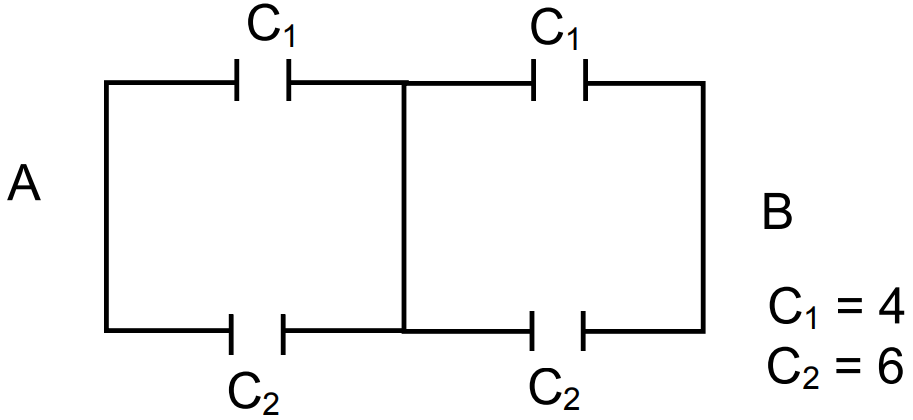
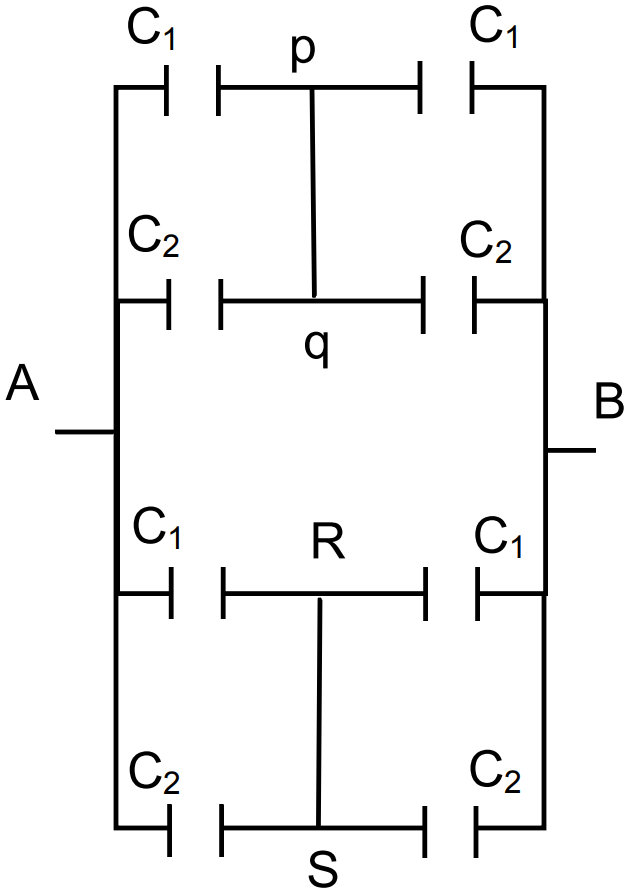
Take $\text{C}_1=4.0\mu\text{F}$ and $\text{C}_2=6.0\mu\text{F}$ in figure. Calculate the equivalent capacitance of the combination between the points indicated.
Answer

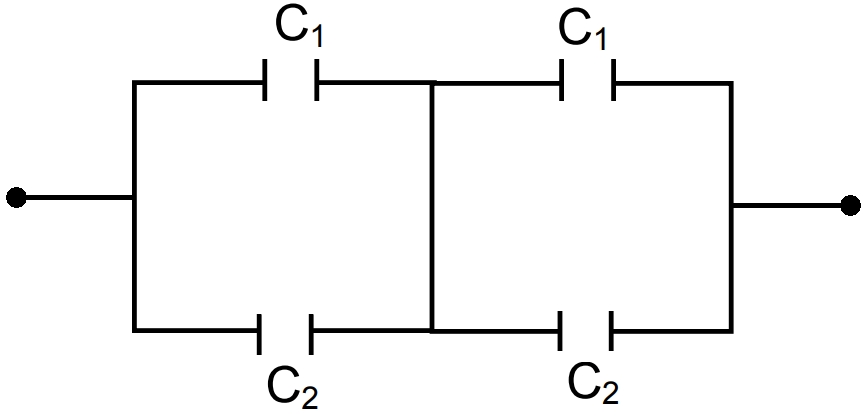
  1. $\therefore C_1, C_1$ are series & $C_2, C_2 $ are series as the V is same at p & q. So no current pass through p & q.

$\frac{1}{\text{C}}=\frac{1}{\text{C}_1}=\frac{1}{\text{C}_2}$
$\Rightarrow\frac{1}{\text{C}}=\frac{1+1}{\text{C}_1\text{C}_2}$
$\text{C}_{\text{p}}=\frac{\text{C}_1}{2}=\frac{4}{2}=2\mu\text{F}$
And $\text{C}_{\text{q}}=\frac{\text{C}_2}{2}=\frac{6}{2}=3\mu\text{F}$
$\therefore\text{C}=\text{C}_{\text{p}}+\text{C}_{\text{q}}=2+3=5\mu\text{F}$
  1. $\text{C}_1=4\mu\text{F},\ \text{C}_2=6\mu\text{F}$

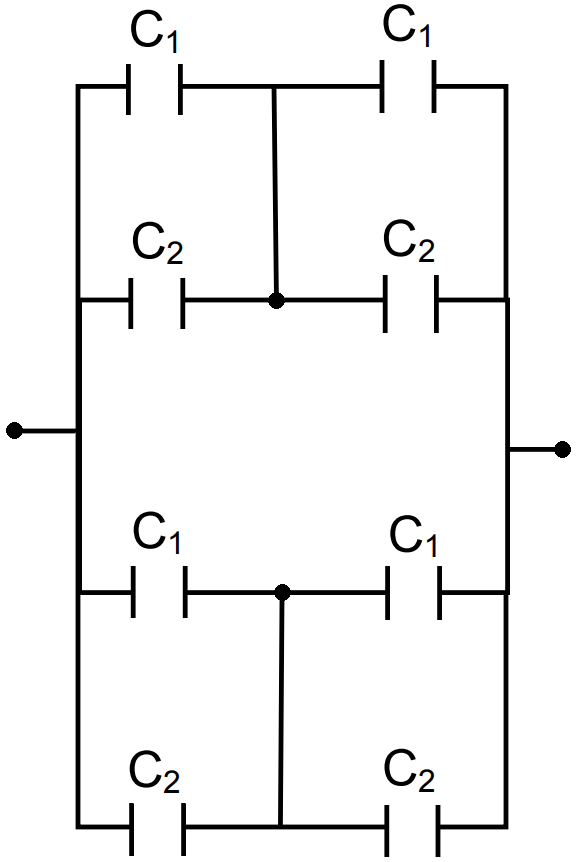
In case of p & q, q = 0
$\therefore\text{C}_{\text{p}}=\frac{\text{C}_1}{2}=\frac{4}{2}=2\mu\text{F}$
$\text{C}_{\text{q}}=\frac{\text{C}_2}{2}=\frac{6}{2}=3\mu\text{F}$
& $\text{C}'=2+3=5\mu\text{F}$
$\text{C}\ \&\ \text{C}' =5\mu\text{F}$
$\therefore$ The equation of capacitor $\text{C}=\text{C}'+\text{C}''=5+5=10\mu\text{F}$

Need a full question paper?

Generate a complete, print-ready paper with questions like this in minutes — across 16+ boards, with answer keys.
Start Generating Free

Similar questions

A compound microscope has a magnifying power of 100 when the image is formed at infinity. The objective has a focal length of 0.5cm and the tube length is 6.5cm. Find the focal length of the eyepiece.
Let there be n resistors $R_1............R_n$ with $R_{max} = max (R_1......... R_n)$ and $R_{min} = min \{R_1 ..... R_n\}.$
Show that when they are connected in parallel, the resultant resistance $R_P < R_{min}$ and when they are connected in series,
 the resultant resistance $R_S > R_{max}.$ Interpret the result physically.
A normal eye has retina 2cm behind the eye-lens. What is the power of the eye-lens when the eye is
  1. Fully relaxed,
  2. Most strained?
Two particles A and B, having opposite charges $2.0 \times 10^{-6}C$ and $2.0 \times 10^{-6}C,$ are placed at a separation of 1.0cm.
  1. Write down the electric dipole moment of this pair.
  2. Calculate the electric field at a point on the axis of the dipole 1.0m awa.y from the centre.
  3. Calculate the electric field at a point on the perpendicular bisector of the dipole and 1.0m away from the centre.
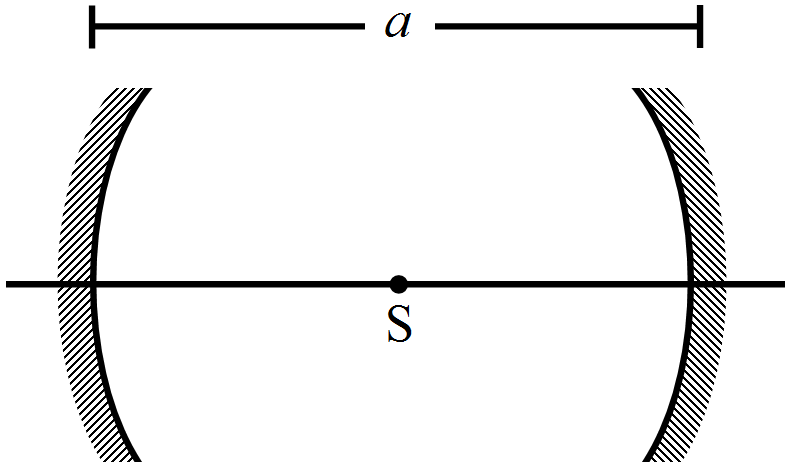
A point source S is placed midway between two converging mirrors having equal focal length f. Find the values of d for which only one image is formed.
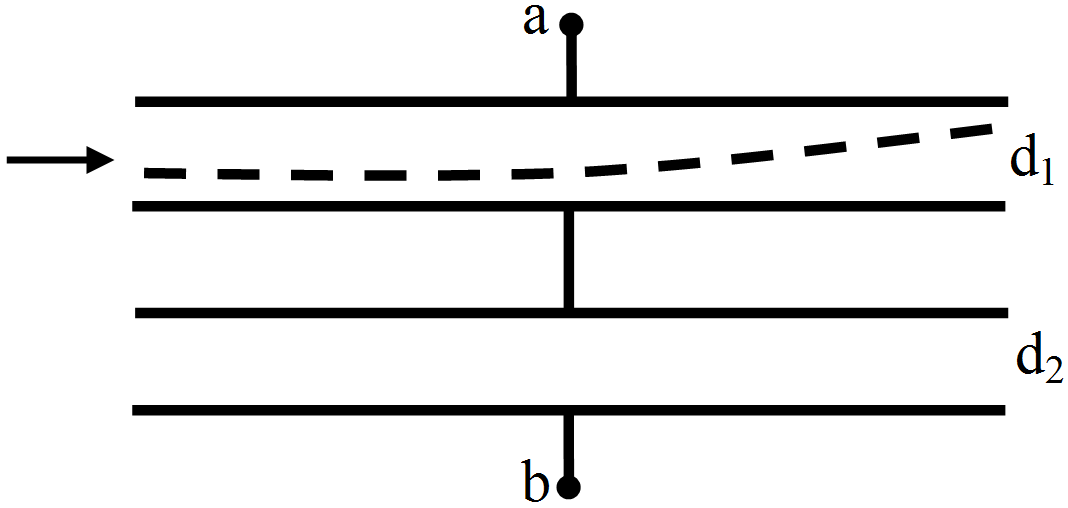
Both the capacitors shown in figure are made of square plates of edge a. The separations between the plates of the capacitors are $d_1$ and $d_2$ as shown in the figure. A potential difference V is applied between the points a and b, An electron is projected between the plates of the upper capacitor along the central line. With what minimum speed should the electron be projected so that it does not collide with any plate? Consider only the electric forces.
A pitcher with 1mm thick porous walls contains 10kg of water. Water comes to its outer surface and evaporates at the rate of $0.1gs^{-1}.$ The surface area of the pitcher $($one side$)= 200cm^2.$ The room temperature = 42°C, latent heat of vaporization $ =2.27\times10^6\text{Jkg}^{-1},$ and the thermal conductivity of the porous walls $=0.80\text{Js}^{-1}\text{m}^{-1}{^{\circ}}\text{C}^{-1}.$ Calculate the temperature of water in the pitcher when it attains a constant value.
Check that the ratio ke$^2$/G $m_em_p$ is dimensionless. Look up a Table of Physical Constants and determine the value of this ratio. What does the ratio signify?
Explain quantitatively the order of magnitude difference between the diamagnetic susceptibility of $N_2 (~5 \times 10^{-9})$ (at STP) and Cu $(~10^{-5}).$
The electric field at a point associated with a light wave is $\text{E}=\big(100\frac{\text{v}}{\text{m}}\big)\sin[(3.0\times10^{15}\text{s}^{-1})\text{t]sin[(6.0}\times10^{15}\text{s}^{-1})\text{t}].$ If this light falls on a metal surface having a work function of 2.0eV, what will be the maximum kinetic energy of the photoelectrons?