Question
What will be the path difference between two light waves $y_1=a_1 \sin \omega t$ and $y_2=a_2 \cos (\omega t+$ $\phi)$ ?

Answer

Equation of first wave
$y_1=a_1 \sin \omega t$
Equation of second wave
$y_2=a_2 \cos (\omega t+\phi)$
or $y_2=\sin \left(\omega t+\phi+\frac{\pi}{2}\right)$
Phase difference between first and second wave
$\Delta \phi=\phi_2-\phi_1$
$=\left(\omega t+\phi+\frac{\pi}{2}\right)-\omega t$
or $\Delta \phi=\phi+\frac{\pi}{2}$
Phase difference due to path difference
$\Delta \phi=\frac{2 \pi}{\lambda} \times \Delta x$
Path difference
$\Delta x=\frac{\Delta \phi \times \lambda}{2 \lambda}$
$\therefore$ For given waves $I^{\text {st }}$ and $2^{\text {nd }}$, the path difference
$\Delta x=\frac{\lambda}{2 \pi}\left(\phi+\frac{\pi}{2}\right)$ $\qquad Ans. $

Need a full question paper?

Generate a complete, print-ready paper with questions like this in minutes — across 16+ boards, with answer keys.
Start Generating Free

Similar questions

Explain Hertz experiment for communication of electromagnetic waves. Draw labelled diagram of apparatus used in the experiment.
$(or)$
Explain Hertz experiment related with electromagnetic waves and also explain experiments of Jagdish Chandra Basu and Marconi.
$(or)$
Critically evaluate Hertz experiment of production and communication of electromagnetic waves.
A paisa coin is made up of Al-Mg alloy and weighs 0.75g. It has a square shape and its diagonal measures 17mm. It is electrically neutral and contains equal amounts of positive and negative charges.
Treating the paisa coins made up of only Al, find the magnitude of equal number of positive and negative charges. What conclusion do you draw from this magnitude?
  1. Explain, giving reasons, the basic difference in converting a galvanometer into (i) a voltmeter and (ii) an ammeter.
  2. Two long straight parallel conductors carrying steady currents $I_1$ and $I_2$ are separated by a distance 'd'. Explain briefly, with the help of a suitable diagram, how the magnetic field due to one conductor acts on the other. Hence deduce the expression for the force acting between the two conductors. Mention the nature of this force.
Air is pumped into the tubes of a cycle rickshaw at a pressure of 2 atm. The volume of each tube at this pressure is $0.002m^3.$ One of the tubes gets punctured and the volume of the tube reduces to $0.0005m^3.$ How many moles of air have leaked out? Assume that the temperature remains constant at 300K and that the air behaves as an ideal gas.
A copper wire having resistance 0.01 ohm in each metre is used to wind a 400-turn solenoid of radius 1.0cm and length 20cm. Find the emf of a battery which when connected the solenoid will eauee a magnetic field of $1.0 \times 10^{-2}T$ near the centre of the solenoid.
$a.$ Using the ray diagram for a system of two lenses of focal lengths $f_1$ and $f_2$ in contact with each other, show that the two lens system can be regarded as equivalent to a single lens of focal length $f$, where
 $\frac{1}{ f }=\frac{1}{ f _1}+\frac{1}{ f _2}$
Also write the relation for the equivalent power of the lens combination.
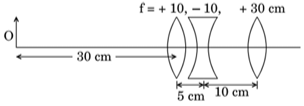
$b.$ Determine the position of the image formed by the lens combination given in the figure. 
Image
A monoenergetic (18 keV) electron beam initially in the horizontal direction is subjected to a horizontal magnetic field of 0.04 G normal to the initial direction. Estimate the up or down deflection of the beam over a distance of 30 cm $(m_e = 9.11 \times 10^{–19} C).$
[Note: Data in this exercise are so chosen that the answer will give you an idea of the effect of earth’s magnetic field on the motion of the electron beam from the electron gun to the screen in a TV set.]
A charge of 8 mC is located at the origin. Calculate the work done in taking a small charge of $–2 \times 10^{–9}$ C from a point P (0, 0, 3 cm) to a point Q (0, 4 cm, 0), via a point R (0, 6 cm, 9 cm).
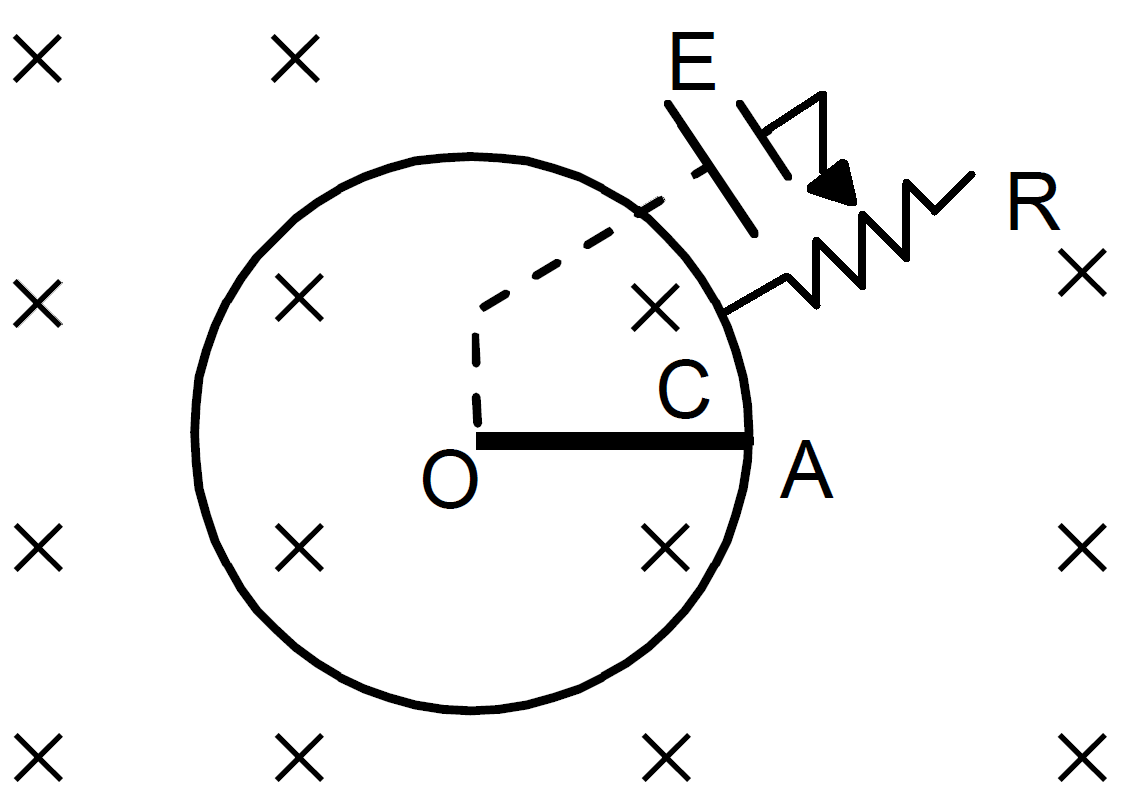
Figure shows a situation similar to the previous problem. All parameters are the same except that a battery of emf $\in$ and a variable resistance R are connected between O and C. The connecting wires have zero resistance. No external force is applied on the rod (except gravity, forces by the magnetic field and by the pivot). In what way should the resistance R be changed so that the rod may rotate with uniform angular velocity in the clockwise direction? Express your answer in terms of the given quantities and the angle $\theta$ made by the rod OA with the horizontal.
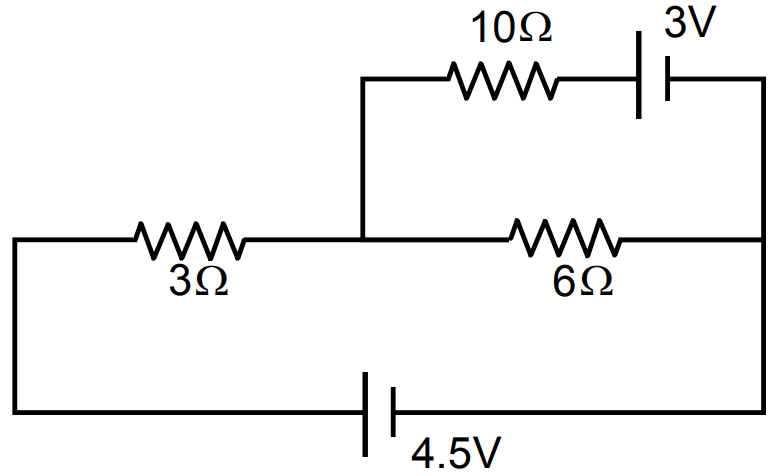
Find the current through the $10\Omega$ resistor shown in figure.